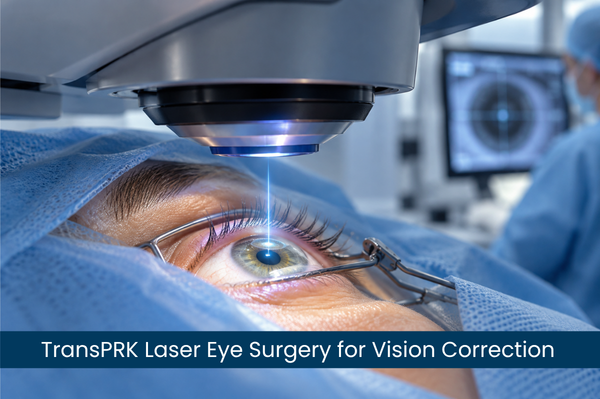
Laser eye surgery can offer life changing results, but suitability depends on more than your glasses prescription. Corneal mapping before laser refractive surgery gives your surgeon a detailed picture of your eye before any treatment decision is made. This article explains what these scans involve and why they matter.
Introduction to Corneal Mapping Before Laser Refractive Surgery
If you wear glasses or contact lenses and are thinking about laser vision correction, your prescription is usually the first thing you share with a clinic. It describes how your eyes focus light, but it does not reflect the structure of your cornea.
This is why corneal mapping before laser refractive surgery, along with other laser eye surgery scans, forms part of a fuller assessment. At Sussex Eye Laser Clinic, Prof. MAYANK A. NANAVATY uses these findings to help guide the conversation around whether treatment may be suitable, or whether further assessment is needed first.
Why a Glasses Prescription Is Not Enough for Laser Eye Surgery
Your prescription records the correction needed for short sight, long sight or astigmatism. Short sight commonly makes distant objects appear blurred, while long sight can affect near vision and sometimes distance vision. Astigmatism can cause blurred or distorted vision at different distances.
The prescription shows the power required to bring your vision into focus, including the degree and axis of any astigmatism, but not the underlying shape of your eye.
Comparing your current prescription with previous ones helps your surgeon assess whether it has remained stable over time, which is one factor considered during assessment.
What Is Corneal Mapping Before Laser Refractive Surgery?
The cornea is the clear, dome shaped surface at the front of the eye, responsible for most of its focusing power. Corneal mapping records its shape, curvature and surface detail in a way that a prescription cannot capture.
During the scan at Sussex Eye Laser Clinic, you are typically asked to look towards a fixed target while the instrument captures measurements across the eye. The process does not involve touching the eye and is usually completed within a few minutes.
The equipment and sequence of tests used can vary between patients, depending on what the surgeon needs to assess for that particular appointment.
You may be asked to have more than one capture of the same eye, simply to confirm the measurements are consistent. This is a standard part of the process rather than a sign that something is wrong.
What Corneal Topography Shows
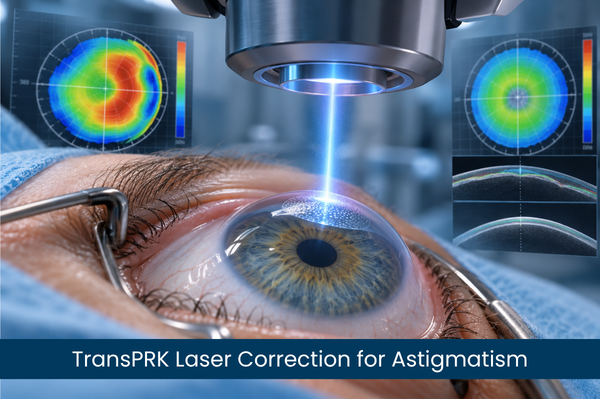
Corneal topography before laser eye surgery produces a coloured map showing the curvature of the cornea across its surface. Your surgeon reads this alongside the underlying measurement data, not the colours alone.
The scan shows the overall symmetry of the cornea and the degree and orientation of any astigmatism present. It can also highlight differences between your right and left eye, even where your prescription for both appears similar.
On a curvature map, warmer colours often represent steeper areas and cooler colours flatter areas. However, the meaning of each colour depends on the scale and type of map displayed.
Your surgeon interprets the pattern and numerical measurements together. A colour alone cannot confirm whether a result is normal or indicate a diagnosis.
Why Corneal Thickness Matters
A corneal thickness assessment measures the thickness of the cornea. Depending on the test used, it may also show how thickness varies across different points. Corneal thickness varies from person to person, and this can influence which treatment approach is appropriate.
Corneal thickness can be measured using pachymetry or a tomography system, depending on the equipment used during your assessment.
Laser refractive surgery reshapes a small amount of corneal tissue to change how light is focused. Your surgeon needs to understand how much tissue is available, and how much is expected to remain afterwards, before any treatment plan can be considered.
There is no single thickness figure that applies to every patient or every procedure. The relevant measurements depend on your corneal shape, your prescription and the specific treatment being discussed.
Corneal Topography and Tomography
While topography maps the front surface, corneal tomography provides a three dimensional view of the cornea. It includes information about the back surface and the distribution of corneal thickness, which can help when an area needs closer examination.
The combination of tests used can vary between patients, depending on what the assessment needs to show.
What an Unusual Corneal Scan May Mean
It is common for a scan to show a pattern that needs a closer look, and this does not automatically mean anything is wrong. Measurements can be affected by recent contact lens wear, dryness on the eye surface or the quality of that particular capture.
Where this happens, your surgeon may ask for the scan to be repeated. If you wear contact lenses, you will be advised how long to leave them out beforehand, as this can vary between patients.
In some cases, an unusual result leads the surgeon to look more closely for signs of conditions such as keratoconus, where the cornea gradually thins and changes shape. An irregular finding on its own does not confirm this diagnosis, and it does not rule out every option for vision correction.
A small variation between a repeated scan and an earlier one is not unusual on its own, and does not necessarily mean your cornea has changed. Your surgeon compares the full set of measurements before deciding whether anything further is needed.
Other Checks Before Laser Vision Correction
Corneal mapping is one part of a broader assessment. Alongside your scan results, your surgeon at Sussex Eye Laser Clinic typically reviews:
- Your general eye health and relevant medical history
- The condition of your eye surface, including any dryness symptoms
- Any previous eye conditions, injuries or procedures
- Your day to day visual needs and what you are hoping to achieve
Dryness on the eye surface is worth mentioning here, since it can affect both comfort during healing and the accuracy of your scan results.
Understanding Your Corneal Scan Results
Once your corneal scan results are available, your surgeon at Sussex Eye Laser Clinic can explain what the measurements show and whether any findings need further assessment.
Questions you may want to raise during this conversation include:
- What do my corneal shape and thickness measurements show?
- Is there anything in my results that needs further investigation?
- What are the next steps if laser treatment is not recommended at this stage?
Corneal Assessment at Sussex Eye Laser Clinic
Sussex Eye Laser Clinic was established in 2014 by Prof. MAYANK A. NANAVATY, with clinics in Brighton, Haywards Heath and Sutton. It offers laser refractive surgery, including LASIK, PRK and LASEK, alongside corneal crosslinking and keratoconus management.
He holds FRCOphth and PhD qualifications and is Chief Examiner for the Certificate of Laser Refractive Surgery at the Royal College of Ophthalmologists. He personally conducts consultations, including the review of corneal mapping results described in this article.
Conclusion
Your glasses prescription is only the starting point for a laser eye surgery assessment. Corneal mapping and thickness scans give your surgeon a fuller picture before Prof. MAYANK A. NANAVATY discusses your results with you.
To understand what your own results mean, arrange a consultation with Sussex Eye Laser Clinic. Questions about keratoconus can be covered in the same conversation.