
TransPRK Laser Eye Surgery is a surface based laser vision correction procedure that reshapes the cornea without creating a corneal flap. It may be considered for selected patients with myopia, astigmatism and some higher prescriptions. Suitability depends on prescription strength, corneal thickness and shape, and overall eye health. A specialist assessment confirms whether it is an appropriate option.
Understanding TransPRK Laser Eye Surgery
TransPRK Laser Eye Surgery is one of several laser vision correction options available to adults who want to reduce their dependence on glasses or contact lenses. Patients often research TransPRK because they want to understand whether it can help with myopia, astigmatism or higher prescriptions, and want to know whether this approach fits their eyes. Understanding how TransPRK treatment works, who may benefit, and what alternatives exist can help patients make an informed decision.
Laser vision correction is not a single treatment. Different procedures work on different layers of the cornea, and the right choice depends on how your eyes are built and how they behave. That is why an examination should come before any decision about treatment.
Prof. MAYANK A. NANAVATY at Sussex Eye Laser Clinic provides specialist guidance to help patients understand suitable vision correction options based on their individual eye health and prescription requirements.
What Is TransPRK Surgery and How Does It Work?
TransPRK stands for transepithelial photorefractive keratectomy. TransPRK surgery is a surface based laser eye procedure in which a single laser treats the cornea from the outside in.
The cornea is the clear front window of the eye. Its outermost layer is the epithelium, a thin protective skin. In TransPRK, the excimer laser first removes this epithelium in a controlled way. The same laser then reshapes the tissue beneath it to correct the refractive error.
This differs from older surface methods that used alcohol or a blade to clear the epithelium before laser treatment. In TransPRK, the whole process is completed with the laser, and no instrument touches the eye during treatment.
The epithelium grows back naturally over the following days. A soft bandage contact lens is usually placed to protect the surface while it heals.
Some patients are considered for this approach because it avoids cutting a flap in the cornea. Whether that matters for you depends on your corneal structure and daily activities, which is discussed later in this article.
TransPRK for Myopia: How Short Sightedness Is Corrected
Myopia, or short sightedness, means distant objects look blurred while near objects remain clear. It usually occurs when the eye is slightly too long or the cornea is too steeply curved, so light focuses in front of the retina instead of on it.
TransPRK for myopia works by flattening the central cornea. Removing a small, precise amount of tissue lowers the focusing power of the eye, allowing light to land on the retina.
Specialists consider several points before recommending treatment for myopia:
- Prescription stability: Vision that is still changing may not give a lasting result. Many specialists look for a stable prescription over at least one year.
- Age: Patients are generally adults, since myopia often progresses through the teenage years and early twenties.
- Pupil size: Large pupils in low light can influence night vision symptoms after treatment.
- Dry eye and surface health: A healthy tear film supports comfortable healing.
Myopia correction with TransPRK aims to reduce reliance on glasses for distance vision. It does not prevent age related changes later in life, such as the need for reading glasses.
TransPRK for Astigmatism: Correcting Uneven Corneal Curvature
Astigmatism is a different problem from myopia. Instead of a round, evenly curved surface like a football, the cornea has a shape closer to a rugby ball, with one meridian steeper than the other. Light then focuses at more than one point, which causes blur or distortion at all distances.
Astigmatism can occur alone or alongside short sightedness or long sightedness.
TransPRK for astigmatism uses the laser to smooth out the uneven curvature. The laser applies a customised pattern of correction based on the direction and amount of astigmatism measured in your eye, so the cornea becomes more evenly shaped.
Accuracy matters more here than in a simple spherical prescription. Corneal topography and tomography maps the front and back surfaces of the cornea, showing the axis and degree of astigmatism in fine detail. These scans also help identify irregular astigmatism, which may point to conditions such as keratoconus.
Two further points shape planning for astigmatism:
- The axis of the treatment must match the axis measured on scans, so the eye is tracked carefully during the procedure.
- Higher levels of astigmatism can need more tissue removal, which influences whether a surface procedure is appropriate.
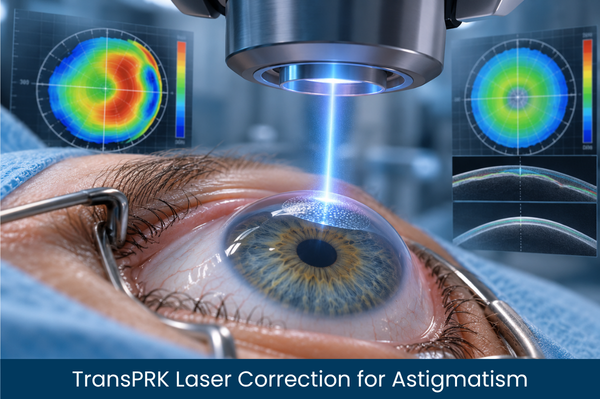
Mild to moderate regular astigmatism is often treatable. Astigmatism caused by an irregular or weakened cornea generally needs a different discussion altogether.
High Prescription Laser Eye Surgery: Can TransPRK Be Considered?
Patients with stronger prescriptions often ask whether they are still candidates for laser correction. The answer depends on the amount of tissue the treatment requires and how much the cornea can safely spare.
High prescription laser eye surgery removes more corneal tissue than a low prescription treatment. Specialists therefore look closely at:
- Corneal thickness: A cornea needs to keep enough untouched tissue after treatment to remain structurally stable.
- Corneal shape: Steep or flat corneas alter how much correction is practical.
- Combined errors: Strong myopia together with astigmatism increases the total amount of correction needed.
- Eye health: Conditions such as glaucoma, retinal disease or inflammation affect planning.
Deeper surface treatments carry a higher chance of corneal haze during healing, and specialists may use measures to reduce this. The recovery period can also feel more demanding than for a lower prescription.
Some complex prescriptions fall outside what laser reshaping can address safely. Very high myopia, a thin cornea or an unusual corneal shape may lead a specialist to advise another approach. Being told that TransPRK is not suitable is not a poor outcome. It reflects a decision made to protect long term eye health.
Customised Laser Correction and Personalised TransPRK Treatment Planning
Before any TransPRK procedure, specialists analyse multiple measurements to create a treatment approach suited to your eye. A well planned procedure starts with measurements and ends with a recommendation that matches your eyes and your goals.
Key elements of personalised treatment planning include:
- Individual eye measurements: Corneal thickness, curvature, pupil size and axial length of the eye.
- Prescription analysis: Comparing your current glasses prescription with a detailed refraction and checking that it has remained stable.
- Corneal evaluation: Scans to look for irregularities that could rule out or change the treatment.
- Lifestyle considerations: Contact sports, dusty workplaces, night driving and the ability to take time off for recovery.
- Long term vision goals: Whether you hope to be free of glasses for most tasks, and how you feel about needing reading glasses later.
This information helps specialists create a treatment plan tailored to the shape and requirements of each eye. Laser systems can tailor the ablation pattern to the measured eye, and the specialist then decides which procedure suits the results.
Prof. MAYANK A. NANAVATY at Sussex Eye Laser Clinic provides personalised consultation and treatment guidance based on individual patient requirements.
TransPRK Treatment Compared With Other Laser Vision Correction Options
Several refractive surgery options exist, and none is universally better than another. Each one suits a different set of eyes and priorities.
LASIK
LASIK creates a thin hinged flap in the cornea, folds it back, reshapes the underlying tissue with the excimer laser and repositions the flap. Because the surface is left largely intact, discomfort in the first days is often mild and vision tends to improve quickly. It generally suits patients with adequate corneal thickness and healthy corneal shape.
PRK and TransPRK
Traditional PRK removes the epithelium before laser treatment, using alcohol or a brush. TransPRK achieves the same step with the laser itself. Both are surface based, so no flap is made. Specialists may consider them for patients with thinner corneas, or those whose work or sport carries a risk of eye impact, since there is no flap to displace. Healing is slower than after LASIK, and early vision can fluctuate for several days.
Other vision correction procedures
Laser reshaping is not the only route. Implantable contact lens surgery places a lens inside the eye and leaves the cornea untouched. It is often considered for very high myopia or corneas too thin for laser. Refractive lens exchange replaces the natural lens and may suit older patients with early lens changes.
The right choice comes from measurements and a discussion with a specialist, and not from a ranking of procedures.
Refractive Surgery Options: When Might Alternative Procedures Be Considered?
Your specialist may suggest a different approach in situations such as these:
- The cornea is too thin to allow the planned correction while keeping enough tissue in reserve.
- Scans show signs of keratoconus or other corneal weakness, where removing tissue could worsen stability.
- The prescription is beyond the range that laser can treat safely.
- Significant dry eye is present that would be aggravated by surface treatment.
- Early cataract changes are developing, in which case treating the lens may address vision more directly.
In these cases the aim remains the same, which is to find a safe route to clearer vision. Sometimes that route is implantable lens surgery, and sometimes it is continued use of glasses or contact lenses, with monitoring.
Testimonials
“I have seen Mr. Nanavaty several times, and on every occasion, he has been professional, friendly and reassuring. He always takes the time to listen and makes me feel comfortable and well cared for throughout my appointments.”
Laser Eye Surgery Consultation: What to Expect Before TransPRK Surgery
A laser eye surgery consultation is where suitability for TransPRK surgery is decided. It is also your opportunity to ask about risks, recovery and realistic outcomes.
You can expect the following:
- Preparation: Contact lens wearers are usually asked to stop wearing them before the visit, since lenses temporarily change corneal shape. Bring your current glasses and prescription.
- Examination: Vision tests, refraction, eye pressure checks, pupil measurement and a full assessment of the front and back of the eye.
- Corneal scans: Detailed maps of thickness and curvature.
- Discussion: Your medical history, medications, work and hobbies, and expectations from treatment.
- Recommendation: An explanation of whether TransPRK, another laser option or a different procedure suits you, and why.
Recovery expectations should be part of that conversation. After TransPRK, most patients experience some discomfort, light sensitivity and watering during the first few days while the surface heals. Vision usually improves gradually over the following days and weeks, although recovery timelines vary between patients, and it can continue to settle for longer.
Aftercare typically involves prescribed eye drops, protective habits such as avoiding rubbing the eyes, and scheduled follow up visits. Knowing this in advance helps you plan time away from demanding tasks and decide whether a surface based approach fits your routine.
 Email Us
Sussex Eye Laser Clinic: Support for Patients Considering TransPRK Surgery
Sussex Eye Laser Clinic is a specialist vision correction provider that offers assessment across a range of refractive surgery options, including laser surface procedures and lens based alternatives where appropriate, so recommendations are not limited to a single procedure.
Patients can expect:
- Detailed eye assessments using modern diagnostic
- Evaluation of myopia, astigmatism and complex prescriptions, including those where laser treatment may not be advisable.
- Personalised laser vision correction recommendations that explain the reasoning behind the advice.
- Specialist consultation with Prof. MAYANK A. NANAVATY, an ophthalmologist experienced in refractive and corneal care.
- Clear guidance on preparation, recovery and follow up throughout the treatment journey.
The intention is to help patients make an informed decision at their own pace, with treatment offered only where it is appropriate for their eyes.
Conclusion: Choosing the Right Laser Vision Correction
TransPRK Laser Eye Surgery may be considered for selected patients with myopia, astigmatism and certain complex prescriptions. It offers a flapless, surface based way of reshaping the cornea, but it is one option among several.
Suitability for TransPRK surgery depends on individual eye assessment, including prescription stability, corneal thickness, corneal shape and general eye health. Personalised planning then helps identify which vision correction option fits your needs and long term goals.
A specialist consultation is the most reliable step before deciding on laser eye surgery. If you are researching options for your own prescription, booking an assessment gives you clear, individual answers.