
The types of laser eye surgery include LASIK, PRK and TransPRK, and each can be considered for myopia, hyperopia or astigmatism depending on the eye. Laser correction flattens the cornea for short sightedness, steepens it for long sightedness and evens out its curvature for astigmatism. No single procedure suits everyone, because corneal thickness, prescription and eye health help determine the most suitable option. A specialist assessment shows which approach fits your eyes.
Types of Laser Eye Surgery for Different Vision Problems
Patients often start their research with one question: which laser procedure suits my prescription? The types of laser eye surgery available today are designed to address different refractive errors, including myopia, hyperopia and astigmatism. However, the most suitable approach depends on your eye structure, prescription and overall eye health rather than the popularity of a particular procedure.
That is why a professional assessment should come before any decision about a procedure. Prof. MAYANK A. NANAVATY at Sussex Eye Laser Clinic provides specialist guidance to help patients understand suitable vision correction options based on their individual eye condition.
How Laser Vision Correction Works for Refractive Errors
A refractive error occurs when the eye does not bend light accurately onto the retina, the light sensitive layer at the back of the eye. When focus falls in front of or behind the retina, or unevenly across it, images look blurred. These refractive errors fall into three common groups:
- Myopia (short sightedness): distant objects look blurred while near objects remain clear.
- Hyperopia (long sightedness): focusing effort increases, and near tasks can become tiring or blurred.
- Astigmatism: vision is distorted at all distances because the eye does not focus light evenly.
Laser vision correction works by reshaping the cornea, the clear front surface of the eye that provides most of its focusing power. An excimer laser removes microscopic amounts of tissue in a precise pattern, changing how the cornea bends light. The pattern differs for each error, as the table and sections below show.
|
Vision problem |
Possible approach |
Key considerations |
|
Myopia |
LASIK, PRK or TransPRK, with lens based options in selected cases |
Prescription strength, corneal thickness |
|
Hyperopia |
Laser or lens based options |
Age, eye anatomy, prescription strength |
|
Astigmatism |
Customised laser correction |
Corneal shape and axis |
Laser Eye Surgery for Myopia (Short Sightedness)
In myopia, the eye is often slightly too long or the cornea too steep, so light focuses in front of the retina.
Laser eye surgery for myopia works by flattening the central cornea, which moves the focal point back onto the retina. The amount of tissue removed increases with the strength of the prescription, so higher prescriptions need closer evaluation.
Patients who may be considered suitable generally have:
- Healthy eyes without active infection, significant dry eye or corneal disease.
- A prescription that has remained stable, usually for at least a year.
- Adequate corneal thickness for the planned correction.
Other myopia treatment options may include implantable contact lens procedures where the prescription is very high or the cornea is thin.
Hyperopia Correction and Long Sightedness Laser Options
In hyperopia, the eye is often slightly short or the cornea too flat, so light focuses behind the retina. Younger patients may compensate by focusing harder, which can cause headaches and eye strain, but that ability weakens with age and distance vision can blur as well.
Hyperopia correction with a laser follows the opposite principle to myopia. The laser steepens the central cornea by reshaping its outer zone, which increases focusing power.
Specialists weigh several factors before recommending treatment:
- Prescription strength: laser correction is generally most predictable for low to moderate long sightedness.
- Age: hyperopia and age related near vision changes can overlap, which affects the choice of approach.
- Eye anatomy: some hyperopic eyes have a shallow front chamber, which influences which options are appropriate.
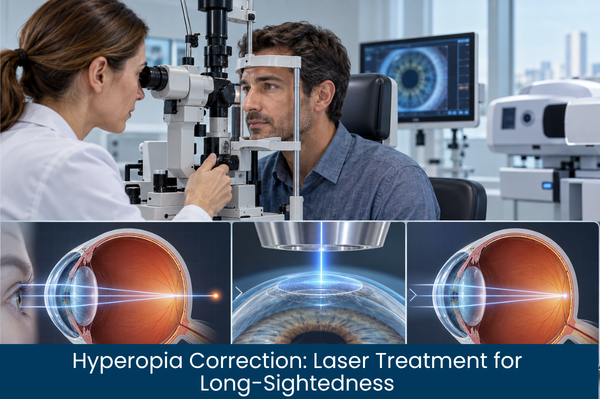
Suitability varies because long sightedness can arise from different eye structures. Long sightedness correction may involve a laser procedure for some patients and a lens based option for others.
Laser Surgery for Astigmatism and Treatment Options
Astigmatism occurs when the cornea, or sometimes the lens inside the eye, is shaped less like a round ball and more like a rugby ball. Light then focuses at more than one point, creating blur or ghosting at every distance.
Laser surgery for astigmatism smooths the cornea so that its curvature becomes more even in all directions. Because astigmatism involves uneven curvature, the laser correction is customised according to the direction and amount of irregularity in the cornea.
Planning differs from other refractive errors because the axis, meaning the direction of the astigmatism, must be aligned precisely. Modern systems use iris recognition and eye tracking to compensate for small rotations of the eye between measurement and treatment.
Accurate measurements are essential. Corneal mapping, known as topography or tomography, shows the exact shape of the front and back surfaces of the cornea. It can also reveal irregular astigmatism or early keratoconus, a condition in which the cornea thins and bulges, which may make laser correction inappropriate.
Why One Type of Laser Eye Surgery Does Not Suit Everyone
Two people with the same glasses prescription can have quite different eyes. Several differences affect which procedure is appropriate:
- Corneal thickness: thinner corneas leave less tissue for reshaping and may favour a surface based or non laser approach.
- Prescription stability: a changing prescription may affect the timing of treatment.
- Eye surface health: dry eye symptoms may influence suitability.
Choosing a procedure because it is widely advertised, or because a friend had it, can lead to a mismatch. Specialists recommend treatment only after judging whether it is safe and likely to meet the patient’s goals.
Personalised Assessments and Customised Laser Eye Surgery
A laser eye surgery consultation allows specialists to review your prescription, eye health and lifestyle requirements before recommending a suitable approach. It typically includes:
- Detailed eye examination: checking the health of the eye surface, lens, retina and tear film.
- Corneal measurements: thickness mapping, curvature and shape analysis.
- Prescription evaluation: confirming the current refraction and reviewing earlier records for stability.
- Lifestyle discussion: understanding work, hobbies, driving needs and screen use.
This is the basis of customised laser eye surgery: the procedure is matched to the eye and the person, rather than the person being fitted to a standard procedure.
Prof. MAYANK A. NANAVATY provides specialist consultation and personalised guidance at Sussex Eye Laser Clinic.
LASIK, PRK and TransPRK: Common Laser Eye Surgery Options
LASIK
LASIK creates a thin hinged flap on the corneal surface. The flap is lifted, the excimer laser reshapes the tissue beneath, and the flap is replaced. It is commonly considered for patients with sufficient corneal thickness and healthy, stable corneas. Visual recovery is usually quick.
PRK and TransPRK
PRK is a surface based treatment. The thin outer layer of the cornea, the epithelium, is removed, the laser reshapes the surface, and the epithelium regrows over the following days. No flap is created.
TransPRK is a modern variation in which the laser removes the epithelium and reshapes the cornea in one continuous, no touch sequence. Surface treatments may be considered for thinner corneas, for people whose work or sport carries a risk of eye impact, or where a flap is not preferred. Healing takes longer than with a flap procedure.
Other Vision Correction Approaches
Other vision correction approaches may also be considered in selected cases, including lens based procedures where laser correction is not suitable. The right choice rests on individual assessment and specialist judgement.
Testimonials
“I have seen Mr. Nanavaty several times, and on every occasion, he has been professional, friendly and reassuring. He always takes the time to listen and makes me feel comfortable and well cared for throughout my appointments.”
Choosing Laser Eye Surgery: Questions for Your Consultation
The most useful question is not which procedure is popular but which is suitable for this eye and these goals. At a laser eye surgery consultation, it helps to ask:
- Am I a suitable candidate for laser correction, and if not, why?
- Which procedures were considered for my eyes, and why was one preferred?
- What are the realistic outcomes and possible risks for me?
- How long is recovery, and when can I return to work, driving and exercise?
Long term vision goals matter too, including how age related near vision changes may affect future needs.
 Email
Email
Laser Vision Correction at Sussex Eye Laser Clinic
Sussex Eye Laser Clinic offers specialist vision correction services for patients with myopia, hyperopia and astigmatism. Care begins with a comprehensive eye assessment that examines eye health and the measurements needed to plan treatment.
Patients receive a discussion of the vision correction options that may suit them, with clear explanations of why an option is recommended or not advised. Prof. MAYANK A. NANAVATY brings specialist ophthalmology expertise to these consultations, and the approach stays patient focused from the initial assessment through treatment planning and aftercare.
Conclusion: Choosing the Right Laser Eye Surgery
Different types of laser eye surgery exist because short sightedness, long sightedness and astigmatism affect the eye in different ways. No single procedure is right for every patient, so each eye needs its own assessment.
A specialist consultation is the most reliable way to understand which option matches your eyes, lifestyle and vision goals. You can arrange an assessment with Prof. MAYANK A. NANAVATY at Sussex Eye Laser Clinic to discuss suitable vision correction options.