
Understanding Clear Lens Exchange and RLE: An Introduction to Lens Replacement Surgery
Many patients researching vision correction options ask the same question: is RLE the same as Clear Lens Exchange, or are they different treatments? When comparing Clear Lens Exchange vs RLE, the short answer is that both describe closely related forms of lens replacement surgery, though the terms are applied slightly differently depending on the patient.
Both procedures involve removing the eye’s natural lens and replacing it with an artificial intraocular lens (IOL). This approach can correct refractive errors and reduce dependence on glasses, and it is often considered an alternative to laser eye surgery by adults experiencing age related vision changes.
While the two terms are frequently used interchangeably, there are some subtle distinctions worth understanding before deciding which option may suit your eyes. Patients researching RLE eye surgery often compare it with Clear Lens Exchange to understand which option may suit their vision goals.
What Is Clear Lens Exchange? Clear Lens Replacement Explained
Clear Lens Exchange, often shortened to CLE, is a procedure in which the eye’s natural lens is removed while it is still clear, meaning before any cataract has developed.
During the procedure, the surgeon removes the natural lens through a small incision and replaces it with an artificial lens implant. The new lens is selected based on measurements taken during a pre surgery assessment.
Patients often choose CLE to address refractive errors such as long sightedness or short sightedness, particularly when glasses or contact lenses have become inconvenient or when laser eye surgery is not considered a suitable option.
Suitable candidates typically include:
- Adults with stable prescriptions who want long term vision correction
- People with higher levels of long sightedness or short sightedness
- Patients who are not ideal candidates for corneal laser surgery
- Individuals who want to avoid developing a cataract in the treated natural lens, as the replaced artificial lens cannot develop cataracts
What Is RLE Eye Surgery and How Does Refractive Lens Exchange Work?
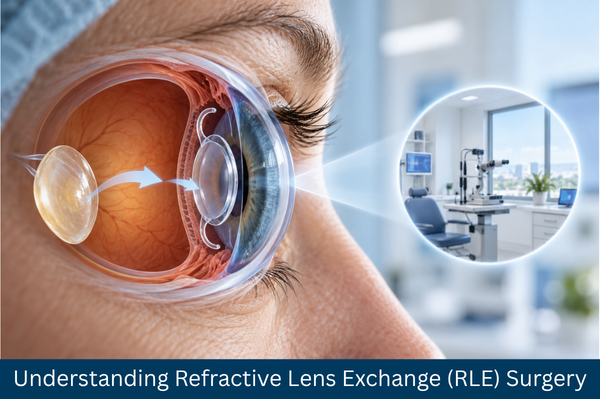
Refractive Lens Exchange, known as RLE, follows the same surgical principle as Clear Lens Exchange. The natural lens is removed and replaced with an artificial lens implant to correct vision problems.
RLE eye surgery is closely related to cataract surgery, since both procedures involve removing the natural lens and inserting a replacement lens. The main difference is that RLE is performed for refractive purposes rather than because a cataract has formed.
RLE can be used to treat a range of vision problems, including:
- Long sightedness
- Short sightedness
- Presbyopia, which affects near vision with age
- Astigmatism, when combined with a toric lens
Several lens options are available for RLE, including monofocal, multifocal, extended depth of focus, and toric lenses. Recovery is generally similar to cataract surgery, with most patients noticing improved vision within a few days, followed by continued settling over several weeks.
Clear Lens Exchange and RLE: Are They the Same Procedure?
The two names are often used interchangeably in patient information and clinical discussion, and in practice many surgeons use them to describe the same underlying procedure.
Where a distinction is drawn, it tends to relate to how the terminology is applied rather than to any difference in the surgery itself, and can depend on:
- The patient’s age at the time of treatment
- Whether presbyopia is a primary concern
- The specific vision correction goals discussed during assessment
A detailed consultation with an ophthalmic surgeon is the best way to understand which term applies to your individual situation.
Clear Lens Exchange vs RLE: Key Differences
The table below summarises how the two terms are typically applied in clinical practice.
| Factor | Clear Lens Exchange | RLE |
| Main purpose | Vision correction before cataract development | Refractive correction and presbyopia management |
| Natural lens | Clear lens removed | Clear lens removed |
| Replacement lens | Artificial IOL | Artificial IOL |
| Common candidates | Patients unsuitable for laser surgery or with higher prescriptions | Adults with refractive errors and age related vision changes |
| Relation to cataract surgery | Similar surgical technique | Similar surgical technique |
Patient Age Considerations
Age can influence which term is used and which lens options are recommended. Younger patients with high prescriptions may be described as undergoing CLE, while patients in their forties and older who are also experiencing presbyopia are more often described as having RLE.
An individual eye assessment is essential in every case, since visual needs vary significantly between patients of similar ages.
Vision Problems Addressed
Both procedures can address:
- Long sightedness
- Short sightedness
- Presbyopia
- Astigmatism, when a toric lens is used
The choice of lens implant plays a significant role in how much a patient can reduce their dependence on reading glasses after surgery.
 Email Us
Lens Options
Lens replacement surgery can use several types of intraocular lenses:
- Monofocal lenses, which provide clear vision at one distance
- Multifocal lens implants, which aim to provide vision at multiple distances
- Extended depth of focus lenses, which offer a broader range of clear vision
- Toric lenses, designed to correct astigmatism
A premium intraocular lens may be recommended for patients seeking reduced dependence on glasses across several distances, though suitability depends on individual eye health and lifestyle needs.
Is RLE Better Than Clear Lens Exchange?
Neither option is considered universally better. Since both procedures use the same lens replacement technique, the choice depends on individual factors rather than one treatment being superior to the other.
Factors that influence which option may be more suitable include:
- Patient age
- Current prescription
- Presence of presbyopia
- General eye health
- Lifestyle and visual requirements
An ophthalmic surgeon can advise which approach is likely to suit a patient’s eyes best after a detailed assessment, rather than recommending one term over the other by default.
How Does Lens Replacement Surgery Work? Step by Step
Lens replacement surgery follows a well established sequence of steps.
- A thorough pre surgery eye assessment is carried out, including checks for general eye health
- Detailed measurements are taken to help select the most appropriate lens implant
- A small incision is made in the eye under local anaesthetic
- The natural lens is gently removed using a small ultrasound probe
- The artificial lens implant is placed into the same position as the natural lens
- The eye is left to heal naturally, often without the need for stitches
Most procedures are completed within a short appointment, and the second eye is usually treated separately, often a week or two later.
Benefits of Clear Lens Exchange and RLE Eye Surgery
Patients considering lens replacement surgery often ask what practical difference it can make to daily life. Reported benefits include:
- Reduced dependence on glasses for many daily activities
- Correction of multiple vision problems in a single procedure
- Long lasting vision correction, since the artificial lens does not wear out in the way natural vision can change
- No future risk of cataract development in the treated eye, as the natural lens has been replaced
- Improved convenience for activities such as reading, driving, and screen use
Individual results vary, and outcomes depend on eye health, lens choice, and the surgeon’s assessment during consultation.
Risks and Considerations Before Lens Replacement Surgery
As with any surgical procedure, lens replacement surgery carries some risks and requires careful assessment beforehand.
Patients should be aware of possible visual side effects, which can include:
- Glare or halos around lights, particularly at night
- Temporary dry eye symptoms following surgery
- A period of adjustment while the eyes settle into their new visual pattern
Every patient requires an individual evaluation to confirm suitability, since factors such as eye health, corneal shape, and general medical history can influence the recommended approach. Realistic expectations, discussed openly during consultation, help support a positive experience.
Testimonials
“Excellent manner, listens really well and gives multiple opportunities to ask questions, which is really helpful. Very calm, gently spoken and not rushed”
Clear Lens Exchange and RLE as an Alternative to Laser Eye Surgery
Laser eye surgery reshapes the cornea to correct vision, while Clear Lens Exchange and RLE replace the natural lens inside the eye. This is a fundamental difference in approach rather than simply a difference in technique.
Some patients are more suited to lens replacement than laser correction, particularly those with:
- Higher prescriptions that fall outside the range suitable for laser treatment
- Early signs of presbyopia affecting near vision
- Thinner corneas that may not be appropriate for corneal reshaping
An eye specialist will consider several factors before recommending a suitable option, including:
- Patient age
- Prescription level
- Overall eye health
- Lifestyle and visual requirements
Lens Replacement Surgery Recovery After Clear Lens Exchange or RLE
Recovery after Clear Lens Exchange or RLE eye surgery is generally similar to recovery after cataract surgery.
Most patients notice improved vision within a few days, although full visual stability can take several weeks. Follow up appointments allow the surgeon to monitor healing and check that the artificial lens implant is settling correctly.
Post surgery care typically includes:
- Using prescribed eye drops to support healing and reduce infection risk
- Avoiding strenuous activity and swimming for a short period
- Attending scheduled follow up appointments
- Reporting any unusual symptoms promptly to the clinic
Most patients are able to return to normal daily activities within a few days, with full recovery generally achieved within a few weeks.
 Call Us Now!
Sussex Eye Laser Clinic: Your Cataract Surgeon in Sussex for Lens Replacement Treatment
Sussex Eye Laser Clinic provides detailed eye assessments carried out by consultant ophthalmic surgeon Prof. Mayank A. Nanavaty to help determine whether Clear Lens Exchange, RLE, or another vision correction option is appropriate for each patient. Advanced diagnostic assessment measures corneal shape, lens power, and overall eye health, forming the basis for individual lens selection. Prof. Nanavaty and the clinic’s surgical team bring experience across both cataract and refractive surgery, guiding patients toward the option best suited to their eyes with clear communication and realistic expectations throughout.
Conclusion: Choosing Between Clear Lens Exchange and RLE
Deciding between Clear Lens Exchange and RLE is less about choosing a different procedure and more about understanding which term fits your individual circumstances and goals. Eye measurements, current prescription, presbyopia, and how much you rely on glasses for daily activities all play a part in this decision. A consultation allows a surgeon to assess your eyes directly, discuss suitable lens options, and set realistic expectations for what surgery can achieve, since this individual assessment is what ultimately determines the right path forward.