
In the world of vision correction surgery, two popular procedures stand out for patients in need of improved eyesight: refractive lens exchange (RLE) and cataract surgery. While they share some similarities, such as lens replacement to restore vision, they are designed for different patient needs. Refractive lens exchange is typically aimed at those with refractive errors who wish to reduce their dependence on glasses or contact lenses, while cataract surgery is a treatment for the cloudy lenses that form due to aging.
Understanding the efficacy, recovery times and patient satisfaction associated with each procedure is crucial for patients and healthcare providers alike. This article explores how refractive lens exchange compares to cataract surgery, with a focus on clinical outcomes and patient satisfaction, especially in the context of UK healthcare.

How Does Refractive Lens Exchange (RLE) Differ from Cataract Surgery?
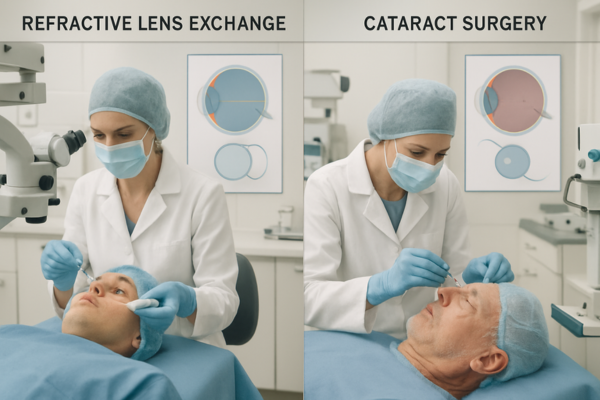
Understanding the Procedures
Refractive lens exchange and cataract surgery are both surgical procedures that involve the removal of the eye’s natural lens and its replacement with an artificial intraocular lens (IOL). However, the primary difference lies in the reason for the surgery.
Refractive Lens Exchange (RLE)
Cataract Surgery
Cataract surgery is specifically aimed at removing a clouded lens caused by aging (or other factors, such as trauma) that impairs vision. The procedure involves removing the opaque lens and replacing it with a clear IOL. Cataract surgery is typically performed on older individuals as part of the natural aging process, but it can also be recommended for younger patients with cataracts due to disease or injury.
Despite their differences in purpose, the techniques and outcomes of these two procedures are often quite similar, particularly with modern advancements in IOL technology.
Read Our Article
Top 7 Myths about Refractive Lens Exchange – DebunkedWhy is Refractive Lens Exchange Becoming More Popular in the UK?
A Growing Demand for Vision Correction Surgery
Refractive lens exchange is increasingly becoming a viable option for individuals in the UK who wish to reduce their dependence on corrective eyewear. With advancements in IOL technology and laser-assisted techniques, RLE offers a compelling alternative to other vision correction procedures, particularly for those with high refractive errors or presbyopia.
Key Benefits of RLE Over Other Procedures
- No Need for Corneal Flaps or Lasers: RLE involves lens replacement, making it a suitable option for patients who may not be candidates for corneal-based procedures due to thin corneas or high refractive errors.
- Dual Purpose Vision Correction: RLE addresses both distance and near vision simultaneously, reducing the need for reading glasses and offering long-term vision correction.
- Prevention of Cataracts: RLE can also serve as a preventive measure for cataracts, which typically develop with age. By replacing the natural lens early, RLE ensures that cataracts do not affect the patient later in life.
These factors contribute to RLE’s increasing popularity as an option for vision correction, especially for middle-aged and older adults in the UK.
Testimonials
“I was a bit hesitant about RLE at first since I didn’t have cataracts yet, but the professional guidance I received here put me completely at ease. They explained how replacing my natural lenses now would correct my vision and mean I’d never need cataract surgery down the line. The precision and care during the procedure were exemplary. My vision is sharper now than it was in my twenties.”
– Fiona Gallagher
How Effective is Refractive Lens Exchange in Terms of Patient Outcomes?
Clinical Success Rates and Visual Improvement
The effectiveness of refractive lens exchange surgery is closely tied to the selection of the appropriate IOL and the precision of the surgical procedure. Most patients experience significant improvements in visual acuity, often achieving better vision after the procedure.
Our Other Treatments
Intense Pulsed Light (IPL) for Dry EyesVisual Outcomes and Benefits
- Improved Visual Acuity: Most patients report dramatic improvements in visual clarity following RLE surgery, with a reduction in their reliance on glasses or contact lenses.
- Reduced Risk of Future Cataracts: By replacing the natural lens early, patients avoid the onset of cataracts, ensuring stable, long-term vision.
Patient Satisfaction
Patient satisfaction with refractive lens exchange is generally high. Most individuals are thrilled with their ability to achieve clear, independent vision at both near and far distances, although recovery times can vary based on the individual’s healing process.
Client Speaks
“As someone who was incredibly nervous about having a lens exchange procedure, I cannot thank the team enough. They were extremely gentle, highly professional, and took the time to keep me fully informed at every stage of the process. The recovery was remarkably quick, and waking up the next day with clear vision without needing contacts or glasses was surreal. I truly could not wish for more.”
– Eleanor Knowles
When Should a Patient Choose Cataract Surgery Over Refractive Lens Exchange?
Choosing the Right Procedure for the Patient’s Needs
Considerations for Cataract Surgery
- Presence of Cataracts: If the patient has developed cataracts, cataract surgery is the obvious choice. Cataract surgery can restore clarity and improve visual acuity, providing patients with long-term benefits.
- Age and Health: Cataract surgery is commonly performed on older adults as part of the natural aging process. It is typically recommended when cataracts impair vision and daily functioning.
Considerations for Refractive Lens Exchange
- Young to Middle-Aged Adults: RLE may be suitable for patients who have significant refractive errors but no cataracts. It is often recommended for those in their 40s and 50s who want to correct their vision and reduce dependence on glasses, while also avoiding future cataracts.
- Desire for Comprehensive Vision Correction: RLE offers an all-in-one solution for patients seeking correction for both near and far vision, making it an ideal option for those looking for a more permanent solution.

Conclusion
Both refractive lens exchange and cataract surgery are effective procedures that offer significant benefits for patients seeking improved vision. While refractive lens exchange is primarily intended for patients with refractive errors who want to reduce their dependence on glasses or contact lenses, cataract surgery is specifically designed to remove cloudy lenses in older adults.
In the UK, both procedures show excellent clinical outcomes, with high patient satisfaction levels, though the decision to pursue one over the other depends on the patient’s unique needs and circumstances. Advancements in IOL technology and surgical techniques continue to improve the effectiveness of both procedures, offering patients clear, long-term vision correction.
Our Other Treatments
Corneal TransplantsFrequently Asked Questions - Refractive Lens Exchange to Cataract Surgery
What is the main difference between cataract surgery and refractive lens exchange?
While both procedures use the exact same surgical technique to replace the eye’s natural lens with an artificial intraocular lens (IOL), the primary difference lies in the medical reason and timing for the surgery. Cataract surgery is a medically necessary procedure performed to remove a natural lens that has become cloudy and yellowed with age, obstructing clear vision. In contrast, Refractive Lens Exchange (RLE) is an elective cosmetic procedure performed on a perfectly clear natural lens, solely to correct refractive errors like severe farsightedness or presbyopia (age-related reading vision loss) for patients wanting to eliminate their dependence on glasses.
Can refractive lens exchange prevent cataracts from developing?
Yes, Refractive Lens Exchange (RLE) completely eliminates the possibility of developing cataracts in the future. Because a cataract is technically the gradual clouding of the eye’s natural, biological lens, replacing it with an advanced, medical-grade artificial intraocular lens (IOL) means there is no longer any natural tissue left to age or become cloudy. The artificial lens implant is permanent, durable, and will remain perfectly clear for the rest of your life, ensuring you will never require cataract surgery down the road.
What are the benefits of refractive lens exchange?
Refractive Lens Exchange (RLE) offers a permanent vision solution for individuals with high prescriptions, thin corneas, or age-related reading vision loss (presbyopia) who may not qualify for standard laser eye surgery. By replacing the eye’s natural lens with an advanced multifocal or extended depth of focus intraocular lens, RLE provides high-definition vision at all distances, drastically reducing or completely eliminating the need for glasses and reading contacts. Additionally, because the natural lens is replaced with a medical-grade artificial implant, RLE completely prevents cataracts from ever developing later in life, ensuring your clear vision remains stable permanently.
How long does it take to recover from cataract surgery or refractive lens exchange?
Most patients experience a noticeable improvement in their vision within 24 to 48 hours after surgery, as the initial post-operative blurriness quickly fades. For the first week, you may experience mild grittiness, light sensitivity, or slight vision fluctuations as the eye adjusts to the new artificial lens. While you can safely return to light everyday activities like reading and working on a computer within a few days, full visual stabilization and complete healing typically take four to six weeks. During this time, your brain adapts to the new optical system, and your doctor will confirm when you are ready for a final prescription update if any minimal reading glasses are still required.
Is refractive lens exchange covered by the NHS?
No, Refractive Lens Exchange (RLE) is generally not available through the NHS because it is classified as an elective lifestyle procedure aimed purely at reducing the need for glasses or contact lenses. The NHS does not fund corrective vision surgeries that are performed solely for cosmetic or refractive convenience. However, if you develop cataracts that significantly impair your daily life, the NHS will fully cover standard cataract surgery to replace the cloudy lens with a basic, clear monofocal lens. If you are seeking RLE to address presbyopia or high prescriptions without cataracts, you will need to choose a private clinic for treatment.