
Artificial Corneal Transplant: Patient Perspectives after the Treatment
Undergoing artificial corneal transplant surgery is a life-changing decision – but what happens once the procedure is done? Most patients focus heavily on surgery day, often overlooking the months that follow. The post-operative journey involves real adjustments: to daily routines, visual expectations and long-term eye care. Understanding this recovery from the patient’s perspective helps set realistic goals and reduces anxiety around the healing process.
Synthetic Corneal Transplant: What the First Few Weeks Actually Feel Like
After a synthetic corneal transplant treatment, the first two to four weeks are the most physically noticeable. Patients commonly report mild to moderate light sensitivity, occasional blurring and a gritty or foreign-body sensation in the eye. These are expected responses as the eye adapts to its new structure.
Most patients are advised to avoid rubbing the eye, swimming and dusty environments during this phase. Eye drops – typically a combination of antibiotic and steroid – become a non-negotiable part of the daily routine. Compliance with this regimen directly affects how well the cornea integrates and stabilises. Patients who follow the post-operative plan closely tend to notice clearer vision beginning to emerge within six to eight weeks.
Read Our Article
Synthetic Corneal Transplants: Causes, Diagnosis and Recovery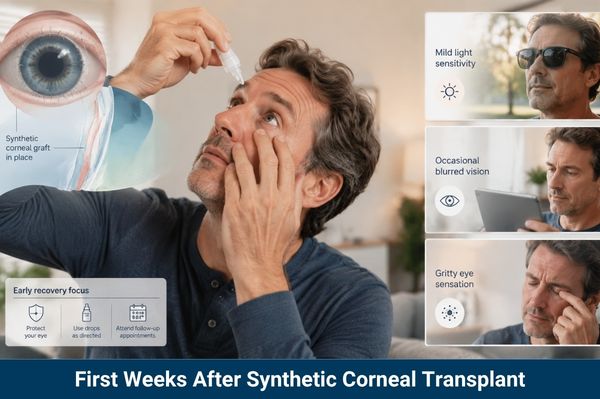
Advanced Synthetic Corneal Transplant Recovery: Managing Daily Life Month by Month
The recovery timeline following a synthetic corneal transplant differs significantly from natural donor transplants, primarily because the risk of immune rejection is eliminated. This alone reduces a major source of long-term stress for patients.
By the end of the first month, many patients can return to office-based or light work. Screen time – whether for reading emails, working on laptops or watching television – is usually manageable with appropriate lighting adjustments. Artificial tears may be recommended to prevent dryness during prolonged screen use.
By months two to three, most patients report feeling increasingly comfortable in social settings, travelling short distances and carrying out household tasks independently. However, activities requiring sharp visual precision – such as detailed craftwork or night driving – may still present challenges and should be discussed with the treating surgeon.
Artificial Corneal Transplant Surgery: Is It Safe for Driving?
One of the most common questions patients raise after artificial corneal transplant is: when can I drive again? The answer depends on visual acuity in the treated eye, depth perception and whether the fellow eye compensates adequately.
In the UK, the DVLA requires a minimum visual acuity of 6/12 on the Snellen chart and an adequate visual field to drive legally. Most patients who have undergone advanced corneal transplant surgery reach this threshold within three to six months, although individual outcomes vary.
Patients are advised not to self-assess their fitness to drive – a formal vision assessment by the surgeon is essential before returning to the road. Night driving, in particular, may remain affected for longer due to residual higher-order aberrations or halos around lights. Wearing anti-reflective spectacles during night driving is often helpful in this phase.
Our Other Treatments
Refractive Lens Exchange SurgeryTestimonials
“Excellent manner, listens really well and gives multiple opportunities to ask questions, which is really helpful. Very calm, gently spoken and not rushed”
Advanced Corneal Transplant: Reading near Vision Expectations Post-Surgery
Reading is one of the first functional activities patients want to resume after an advanced corneal transplant. Close-up tasks depend on corneal clarity, accommodative ability and the refractive error that remains post-surgery. In many cases, reading glasses or a low prescription may still be required even after a successful procedure.
Patients who undergo partial-thickness procedures tend to retain more natural corneal curvature, which can support better near vision outcomes. Full-thickness replacements may require a period of spectacle correction while the corneal surface stabilises. It is important for patients to understand that visual acuity typically continues to improve gradually for up to twelve months – and in some cases, even beyond that.
Reading in good lighting, using larger fonts on digital devices and avoiding prolonged near-vision tasks in the early months all contribute positively to visual comfort during recovery.
Synthetic Corneal Transplant Treatment and Long-Term Vision: What Patients Can Realistically Expect
Patients often want to know whether their vision will return to what it was before their corneal condition began. Synthetic corneal transplant treatment can significantly restore functional vision, but the outcome depends on multiple factors: the underlying condition, the health of the retina and optic nerve and the patient’s overall ocular anatomy.
For patients treated for conditions like bullous keratopathy or endothelial failure, vision improvement is often substantial. Many achieve vision good enough for driving, reading with mild correction and full participation in daily activities. For those with more complex corneal disease or pre-existing retinal conditions, improvement may be more modest but still meaningful in terms of quality of life.
Long-term follow-up appointments are not optional – they are essential. Regular monitoring of intraocular pressure, corneal clarity and endothelial cell count (where relevant) ensures that any changes are identified early and managed appropriately.
Artificial Corneal Transplant: Emotional and Lifestyle Adjustments Patients Don't Often Talk About
Beyond the clinical metrics, artificial corneal transplant surgery carries a significant emotional dimension. Many patients describe a period of adjustment as their brain recalibrates to new visual input. Some experience mild anxiety when vision fluctuates during healing or when one eye sees more clearly than the other.
Patients with good social support tend to navigate this phase more successfully. Joining patient communities, staying engaged with the treating team and setting small visual milestones – such as reading a newspaper headline or recognising a face at five metres – helps build confidence and track progress meaningfully.
Sleep quality also plays an underappreciated role in corneal healing. Adequate rest supports tissue recovery and patients should avoid sleeping face-down or with pressure on the operated eye during the early post-operative months.
 Call Us Now!
Sussex Eye Laser Clinic
Sussex Eye Laser Clinic, led by Consultant Ophthalmic Surgeon Prof. Mayank A. Nanavaty (MBBS, DO, FRCOphth, PhD), has been delivering specialised eye care since 2014, with over 18 years of clinical expertise in lens- and cornea-based procedures. Operating across Brighton, Haywards Heath and Sutton, the clinic provides a comprehensive range of treatments – from refractive lens exchange and cataract removal surgery to modern corneal transplants, including synthetic options. Every patient receives a personalised consultation and a tailored treatment plan, ensuring informed decisions and optimal visual outcomes.
Our Other Treatments
Implantable Contact Lens SurgeryConclusion
Life after an artificial corneal transplant is a gradual but rewarding journey back to clearer vision. While early weeks demand patience and careful compliance, the months that follow typically bring measurable improvements in reading, driving and daily independence. With realistic expectations, consistent follow-up care and the right clinical expertise, most patients achieve functional vision that meaningfully restores their quality of life.