
Synthetic Transplants Are Solving a Global Crisis: The Donor Cornea Shortage
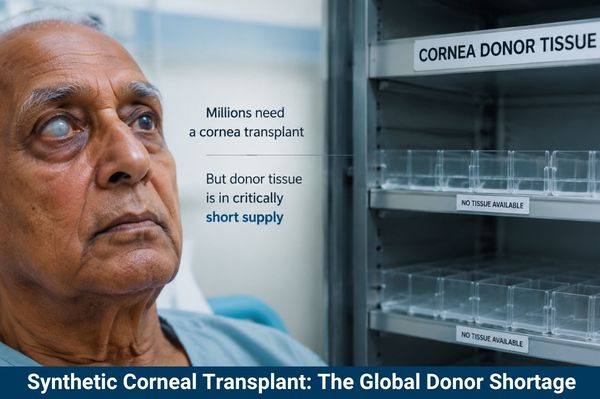
Every year, millions of people worldwide lose its sight – not because treatment doesn’t exist, but because the tissue required to restore it simply isn’t available. Corneal blindness affects an estimated approx. million people globally, yet the demand for donor corneas vastly outpaces supply. This is not a minor gap – it is a crisis. And synthetic corneal transplant technology is now at the forefront of bridging it.
Synthetic Corneal Transplant: Understanding Why the Donor System Is Failing
The traditional corneal transplant model relies entirely on voluntary human donation after death. While countries like the United States and parts of Europe have reasonably functional eye banking systems, the global picture is starkly different. Sub-Saharan Africa, South Asia and Southeast Asia – regions where corneal disease from infections, injuries and nutritional deficiencies is most prevalent – have the least access to donor tissue. Cultural and religious barriers to donation, inadequate cold-chain storage infrastructure and the short viability window of donor corneas compound the shortage further. The result: hundreds of thousands of people remain on transplant waiting lists for years, many going permanently blind in the interim.
Advanced Synthetic Corneal Transplant Technology: What Has Changed
The idea of replacing a damaged cornea with a lab-engineered or biomaterial-based alternative is not new, but the precision and clinical viability of these devices have transformed dramatically over the last decade. Advanced synthetic corneal transplant solutions now include bioengineered constructs made from collagen matrices, hydrogel polymers and decellularised tissue scaffolds that replicate the optical and mechanical properties of a natural cornea. Unlike early-generation keratoprostheses that often required complex surgical management and carried high complication rates, current devices are designed for integration with the host eye, minimising rejection and long-term maintenance concerns. Crucially, they can be manufactured at scale, stored indefinitely and distributed globally – none of which is possible with donor tissue.
Artificial Corneal Transplant Devices: The Key Players Reshaping the Landscape
Among the most clinically validated approaches, the Boston Keratoprosthesis (KPro) has been widely used for patients who have failed multiple donor transplants. However, newer generations of artificial corneal transplant devices are designed not just for refractory cases, but as first-line alternatives. The EndoArt® implant, for instance, is an endothelial keratoprosthesis engineered specifically to replace only the inner layer of the cornea – the endothelium – which is responsible for keeping the cornea clear and is the most commonly failing layer in conditions like Fuchs’ endothelial dystrophy and bullous keratopathy. Unlike full-thickness prostheses, endothelium-targeted synthetic solutions preserve the remaining corneal layers, resulting in better visual outcomes and faster recovery. These devices are manufactured under controlled conditions, free from the biological variability inherent in donor tissue.
Advanced Corneal Transplant Approaches: Matching the Solution to the Disease
One of the most significant shifts in corneal medicine is the move away from full-thickness transplants toward selective lamellar procedures – replacing only the diseased layer. Advanced corneal transplant strategies now follow this layer-specific logic with synthetic materials as well. For patients with anterior stromal disease, such as corneal scarring or keratoconus at advanced stages, anterior lamellar synthetic grafts address the problem without touching the healthy endothelium. For those with endothelial failure, posterior synthetic grafts restore clarity without disrupting the front surface. This stratified approach reduces procedural risk, shortens surgical time and aligns directly with how modern eye surgeons think about corneal architecture. It also means that a single synthetic product type does not need to serve all patients – a more rational and outcomes-driven model than the donor system’s one-size approach.
Testimonials
“Excellent manner, listens really well and gives multiple opportunities to ask questions, which is really helpful. Very calm, gently spoken and not rushed”
Artificial Corneal Transplant Surgery: How the Procedure Compares to Traditional Transplants
In terms of surgical technique, artificial corneal transplant surgery shares considerable overlap with conventional donor-based procedures. Surgeons performing DMEK or DSAEK are already practised in the delicate handling of thin corneal tissue and adapting to synthetic equivalents requires manageable retraining. The primary practical difference lies in preparation: donor tissue must be retrieved, processed and matched at short notice, whereas synthetic grafts can be planned electively ordered in advance and tailored for the patient’s eye dimensions. This changes the surgical workflow significantly. There is no urgency pressure, no last-minute cancellations due to tissue unavailability and no immunological matching requirement. For both surgeons and patients, this represents a more controlled and predictable process. Postoperative care also tends to be more straightforward, as the immune-mediated rejection cascade that complicates donor transplants is substantially reduced with synthetic materials.
Our Other Treatments
Laser Refractive Eye SurgerySynthetic Corneal Transplant Treatment: Who Is It Suitable For?
Synthetic corneal transplant treatment is not universally appropriate for every patient with corneal disease, but the eligible population is substantial. It is particularly well-suited for individuals who have already experienced donor graft rejection, those with conditions that predispose to rejection, patients in regions with no realistic access to eye banks and individuals requiring urgent vision restoration where waiting for a donor is not clinically viable. Patients with Fuchs’ dystrophy – one of the most common indications for endothelial transplantation – represent a major target group, given the scale of the condition and the growing donor shortfall in meeting its demand. For this population, a reliable, off-the-shelf synthetic endothelial implant represents a paradigm shift in access and outcome predictability.
The Systemic Impact: What Scaling Synthetic Solutions Could Mean Globally
If synthetic corneal technology reaches commercial maturity and global distribution, the implications extend well beyond individual surgical outcomes. Eye banks in under-resourced countries would no longer need to compete with wealthier nations for scarce donor tissue. National health systems could plan corneal restoration programmes with reliable supply chains. Surgical training programmes could standardise around consistent graft characteristics rather than adapting to variable donor quality. The downstream burden of corneal blindness – lost productivity, dependence, reduced quality of life – would decrease at population scale. Currently, the WHO estimates that 90% of people with corneal blindness live in low-income countries. The donor system, however well-intentioned, was never built to serve them equitably. Synthetic alternatives can be.
 Call Us Now!
Sussex Eye Laser Clinic - Specialist in Synthetic Corneal Transplant
Sussex Eye Laser Clinic, led by Consultant Ophthalmic Surgeon Prof. Mayank A. Nanavaty (MBBS, DO, FRCOphth, PhD), has been delivering advanced and personalised eye care from Brighton since 2014. With over 18 years of specialist experience in corneal and lens-based surgery, Prof. Nanavaty offers a comprehensive range of treatments – including modern corneal transplants and synthetic implant options such as EndoArt® – across leading hospitals in Sussex, Brighton, Haywards Heath and Sutton. The clinic is committed to clinical excellence, using the latest ophthalmic technology to restore and protect patients’ vision.
Our Other Treatments
YAG Laser CapsulotomyConclusion
The donor cornea shortage is not a problem that goodwill and awareness campaigns alone can solve – it requires structural alternatives and synthetic corneal technology is delivering exactly that. As clinical evidence grows and manufacturing scales, these solutions are moving from niche interventions to viable mainstream options. For the millions waiting – and those who will never reach a waiting list at all – this shift could not come soon enough.