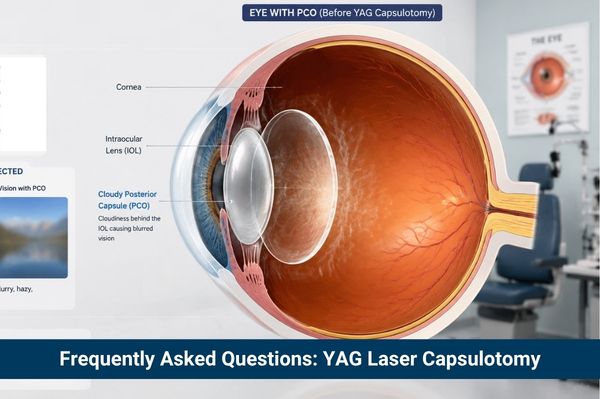
YAG laser capsulotomy is a procedure used to improve vision affected by posterior capsule opacification, and most patients have a straightforward recovery after YAG laser capsulotomy. This guide walks through what floaters after YAG laser capsulotomy usually mean, and the specific signs that call for prompt assessment rather than routine reassurance.
Floaters After YAG Laser Capsulotomy: An Overview
Noticing small floating spots in your vision after YAG laser capsulotomy can feel unsettling, especially when you were expecting your sight to improve. Sussex Eye Laser Clinic sets out below what tends to happen and which changes need urgent attention.
New floaters after YAG treatment, including symptoms accompanied by flashes after YAG laser, should be reported promptly. The guidance below explains when to seek urgent assessment.
When Floaters Need Urgent Assessment
Certain changes in vision after YAG laser treatment call for immediate review by an eye specialist rather than a wait and see approach. Contact your treating team or your local eye emergency service straight away if you notice any of the following:
- Floaters appearing for the first time or increasing suddenly
- A shower of new spots or moving shapes
- New flashes of light
- A dark shadow, curtain or missing area of vision
- Sudden deterioration or blurring of vision
- Significant eye pain or worsening symptoms
These signs can indicate a retinal problem or another complication that needs prompt attention. They do not confirm a diagnosis on their own, but only a clinician can examine the eye and rule out a serious cause.
Use NHS 111 if you cannot promptly reach your treating team or an eye emergency service. Do not wait for pain, several symptoms together or a scheduled review before seeking help.
What Do Eye Floaters After YAG Laser Look Like?
Eye floaters after YAG laser often appear as small dots, threads, rings or cobweb like shapes drifting through your field of vision. They tend to move as your eyes move and gradually settle once your gaze is still.
Many people find them easier to notice against a plain, bright background, such as a clear sky or a white wall, than against a busy or dim scene. The vitreous, the gel like substance that fills the inside of the eye, is where these shapes usually form.
The appearance of a floater alone cannot confirm what is causing it. A drifting spot could be a harmless strand within the eye, or an early sign of something that needs checking by a specialist.
Why Might You Notice Floaters After YAG Laser Capsulotomy?
YAG laser capsulotomy creates a small opening in the cloudy capsule sitting behind an artificial lens, allowing light to reach the back of the eye more easily. Some patients notice tiny particles released during this process, which can appear as new floaters for a short period afterwards.
Floaters noticed around this time are different from posterior capsule opacification symptoms, such as blurred or hazy vision, which the laser treatment itself was carried out to resolve.
Others become more aware of floaters that were already present simply because their vision is clearer than before treatment. Once the cloudiness has gone, existing spots within the vitreous stand out more easily against sharper, more detailed vision.
Timing alone does not confirm that a floater is harmless, so the urgent guidance above still applies to any new or changing floater after treatment.
Flashes After YAG Laser and How They Differ From Floaters
A floater is a drifting spot, thread or shape that moves along with your eye. A flash is a brief streak, flicker or spark of light, often noticed at the edge of your vision rather than straight ahead.
Flashes felt during the YAG laser procedure itself, caused by the laser light, are different from new flashes that develop afterwards at home. Flashes after YAG laser treatment appearing later are not simply another form of floater and should be reported rather than monitored.
Both symptoms can occur together or separately, and either one developing suddenly is a reason to contact your eye care team without delay, following the urgent guidance already outlined above.
What to Tell Your Eye Care Team About New Floaters After YAG Treatment
Having a few details ready can help your eye care team at Sussex Eye Laser Clinic assess new floaters after YAG treatment more quickly, though you should never delay contacting them while gathering this information.
- When the symptoms started
- Which eye is affected
- Whether the number or appearance of floaters has changed
- Whether your vision has become blurred or partly obscured
- The date and location of your YAG laser eye treatment
- Your relevant eye history and any eye drops you currently use
If you do not have every detail to hand, contact your team anyway rather than waiting to gather it all first.
What an Eye Assessment for YAG Laser Capsulotomy Floaters Involves
An eye specialist decides which examinations are appropriate based on your symptoms and your treatment history. This usually includes checking your vision and reviewing what has happened since your laser capsulotomy.
The clinician will examine your eye and may check eye pressure where this is relevant to your symptoms. Dilating your pupil allows a clearer view of the retina at the back of the eye, often needed to properly assess new floaters or flashes.
A description given over the phone or online cannot rule out a retinal tear or detachment. An eye examination, often including a dilated retinal examination, is needed to assess the cause and decide whether treatment or observation is appropriate.
Managing Persistent Floaters After Assessment
This section is for patients who have already had their floaters assessed by an eye specialist. Following the specific advice given after your examination remains important, even once you have been reassured about the cause.
Report any further changes, even if an earlier check up was reassuring at the time. New symptoms appearing after a clear assessment still deserve attention, since both floaters and the eye itself can change over the following weeks or months.
Many patients find that floaters interfere with reading, screen work or other daily activities even after being told there is no serious underlying cause. It is worth raising this impact with your eye care team at your next routine appointment.
There is no guaranteed date by which every floater fades or disappears completely. Some become far less noticeable over time as the brain adapts, while others remain visible for longer, and this varies considerably from one person to the next.
About Sussex Eye Laser Clinic
Sussex Eye Laser Clinic offers YAG laser capsulotomy in Brighton, alongside cataract surgery and other eye treatments. The clinic is led by an experienced consultant ophthalmic surgeon with a focus on personalised eye care.
Discussing your procedure, your current symptoms and your follow up options with Prof. MAYANK A. NANAVATY can help you understand the appropriate next steps for your vision.
Floaters After YAG Laser Capsulotomy: What to Remember
Floaters may become less noticeable after treatment, but their appearance alone cannot establish the cause. New or changing symptoms should be assessed according to the urgent guidance above. For routine questions after assessment, contact Sussex Eye Laser Clinic to discuss follow up with Prof. MAYANK A. NANAVATY. Do not use a routine enquiry form for urgent symptoms.