
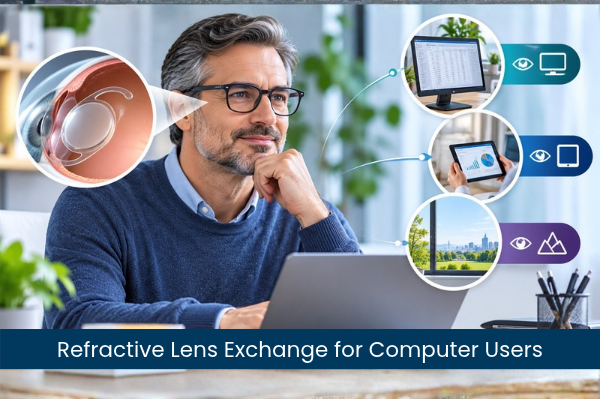
Refractive lens exchange is increasingly discussed by computer users weighing up lens replacement surgery for near and intermediate vision. This guide looks at refractive lens exchange for computer users alongside everyday screen distances, computer vision after lens replacement and realistic expectations for anyone who relies on a monitor throughout the working day.
Introduction to Refractive Lens Exchange for Computer Users
A typical working day rarely involves one single viewing distance. Many people move between a desktop monitor, a laptop, printed paperwork and a mobile phone within the space of an hour. Refractive Lens Exchange for computer users is best discussed with this pattern in mind, rather than as a single question of long distance sight.
Patients considering lens replacement for computer work often want to know how clearly they may see their screen and whether glasses could still be needed. A consultation at Sussex Eye Laser Clinic can help them understand the possible outcomes for their usual working distances.
What Is Refractive Lens Exchange?
Refractive lens exchange replaces the eye’s natural lens with an artificial lens. Some people consider it for presbyopia correction, to reduce their dependence on glasses for age related changes in near vision, or other focusing needs.
Whether the procedure is appropriate for a particular person depends on a full clinical assessment at Sussex Eye Laser Clinic. This includes a discussion of the expected benefits, the possible risks and any alternative options available.
Clear lens exchange, eye lens replacement and refractive lens exchange surgery all describe the same underlying procedure. The terminology used may vary slightly depending on the source, but the principle of replacing the natural lens remains the same.
What Is Intermediate Vision and Why Does It Matter at Work?
Intermediate vision sits between close reading distance and distance vision used for driving or watching television. It covers many of the tasks performed at a desk. RLE intermediate vision planning looks specifically at these middle range tasks, since they often differ noticeably from near reading or distance sight.
Common examples include:
- A desktop monitor positioned at arm’s length
- A laptop screen at a shorter working distance
- A colleague’s face across a meeting table
- A presentation screen viewed from a seated position
No two workstations are set up the same way, so the actual distance involved can vary considerably from one person to the next. When discussing RLE, intermediate vision is worth mentioning if you spend much of your day looking at a monitor, rather than assuming it will be covered automatically.
Discussing computer vision after lens replacement includes considering how far you sit from your screen and how often you switch to closer tasks.
Read Our Article
What to Expect During Your ICL Surgery Consultation?How to Measure Your Computer Working Distance
Before a consultation, it helps to have a clear sense of your own working distances rather than a general impression. A few simple checks can make this easier.
- Sit in your normal working position and estimate the distance from your eyes to your main monitor.
- Note whether you use a laptop, a single large monitor or more than one screen at once.
- Check whether your screens sit at similar distances or noticeably different ones.
- Identify any tasks that involve leaning closer to see fine detail.
Bringing these observations, or even rough measurements, to your appointment gives your surgeon something concrete to work from. A single measurement alone will not determine suitability for treatment, but it does help frame the conversation.
Planning Near and Intermediate Vision for Work
Few jobs involve only one type of visual task. A working day might include reading a printed document, glancing back at a monitor, checking a phone and reviewing a small drawing or figure, often within minutes of each other.
It is worth thinking through which of these transitions happen constantly and which only occur occasionally. Sustained close work, such as proofreading or reviewing detailed spreadsheets, places different demands on your eyes than an occasional glance at a phone screen.
Someone in an accounts role, for example, may switch repeatedly between a spreadsheet on screen, a printed invoice and a calculator within a few minutes. Patterns like this are worth describing to your surgeon rather than simply saying you “use a computer”.
Discussing Your Work Priorities Before Lens Replacement
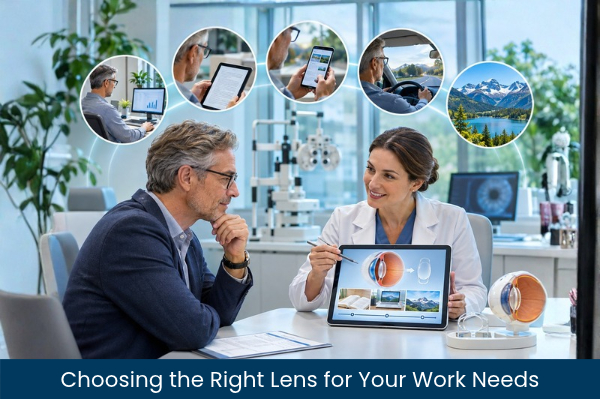
Every role has its own balance of tasks, and it helps to work out your own priorities before your appointment. Consider the following questions.
- Which task occupies the largest share of your working day?
- Do you need to see fine detail, small figures or accurate colour?
- Does driving or other distance vision also matter to you?
- Would you be comfortable wearing glasses for certain activities, even after treatment?
Sharing honest answers to these questions helps your surgeon discuss lens replacement for computer work in the context of your whole working life, not just your screen time.
What to Expect From Computer Vision After Lens Replacement
Treatment planning at Sussex Eye Laser Clinic takes the intended focus of the implanted lens into account, based on the assessment carried out before surgery. Even so, the actual visual outcome can differ from the plan in some cases.
Some patients still need glasses for computer work, close reading, distance vision or specific tasks after lens replacement. Other eye conditions and individual factors can also influence the final result, which is why outcomes are discussed as a range of likely possibilities rather than a single guaranteed figure.
Our Other Treatments
Cataract SurgeryWhy Lighting, Screen Settings and Eye Comfort Still Matter
Regardless of any treatment decision, the way a workstation is set up continues to affect comfort. A few practical adjustments are often worth reviewing.
- Screen brightness and contrast relative to the room
- Text size and display settings
- Glare from windows or overhead lighting
- A comfortable screen height and distance
- Regular breaks during long periods of close work
These adjustments can make daily tasks more comfortable, but they are not a substitute for an eye examination. If discomfort persists, it is worth raising this with an eye care professional rather than relying on workstation changes alone.
It is worth noting that refractive lens exchange is not a treatment for digital eye strain or dry eye on its own. Workstation adjustments and clinical treatment serve different purposes, and both can be relevant depending on what is causing your discomfort.
Benefits and Risks of Refractive Lens Exchange
A balanced conversation about treatment should cover more than the potential advantages. It is worth asking your surgeon to walk through each of the following points.
- Your own visual goals and how treatment might support them
- The limits of predicting an exact outcome in advance
- The possibility that some activities may still require glasses
- The surgical risks involved and what recovery typically looks like
- Whether non surgical options, such as updated glasses, might also meet your needs
Refractive lens exchange is surgery inside the eye and carries risks, including infection, retinal detachment and, rarely, serious permanent loss of vision. Your surgeon at Sussex Eye Laser Clinic can explain how your eye health and prescription affect your individual risks.
Vision correction options are not limited to surgery. For some patients, an updated glasses prescription may address the issue just as well, particularly where computer use is the main concern rather than distance vision.
 Email Us Now!
Preparing for a Refractive Lens Exchange Consultation
Patients researching refractive lens exchange Brighton options often want to know what an initial consultation actually covers. Arriving at your appointment with a clear picture of your working day allows Prof. MAYANK A. NANAVATY to focus the discussion on your specific circumstances at Sussex Eye Laser Clinic.
It is worth bringing along the following.
- Your screen and reading distance notes
- Details of your current glasses or contact lens prescription
- Any difficulties you notice with near, intermediate or distance vision
These points are simply useful preparation, not a checklist that needs to be completed in full before you can book an appointment.
Conclusion
Refractive lens exchange planning works best when it accounts for your full working day rather than a single distance. Thinking through your screen habits, close reading tasks and any distance vision needs gives your surgeon a clearer picture to start from. A clinical assessment will then set out the possible benefits, limitations and alternatives for your eyes.
To discuss your options, contact Sussex Eye Laser Clinic and arrange a consultation with Prof. MAYANK A. NANAVATY. Bringing details of your working day along will help make that first appointment as useful as possible.
