
The diagnosis of a progressive eye disease like keratoconus often brings with it a wave of uncertainty. While much of the clinical conversation revolves around the physical strengthening of the eye, the mental and emotional journey is equally significant. Corneal Collagen Crosslinking has revolutionized the physiological management of this condition, but for the patient, the procedure represents a pivotal shift in their relationship with their sight. Navigating the “new normal” after surgery requires more than just clinical drops; it requires a robust understanding of the psychological landscape that accompanies recovery.
Corneal Crosslinking Visual Evolution: Understanding Changes Post-Treatment
The immediate period following Corneal Cross-linking is often a sensory rollercoaster. Unlike many elective laser eye surgeries that promise “instant” clarity, CXL is a foundational treatment. Its primary goal is to stabilize the corneal collagen fibers, but the road to that stability involves a series of visual fluctuations that can be taxing for the patient.
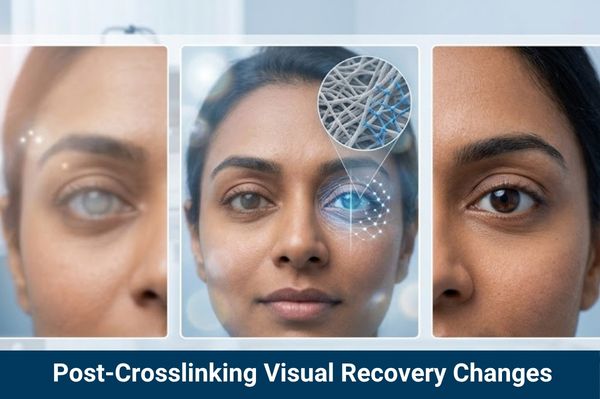
In the days and weeks following the procedure, patients often report a temporary increase in blurriness or a “hazy” quality to their vision. This occurs as the corneal epithelium heals and the newly formed cross-links settle into place. Furthermore, sensitivity to light (photophobia) and the appearance of halos or glare around bright lights can be more pronounced. For a patient already worried about their sight, these temporary setbacks can feel like a regression.
However, as the eye heals, many begin to notice a sense of visual “solidarity.” While Corneal Collagen Cross-linking is not marketed as a refractive cure, the subtle flattening of the corneal cone often leads to a more predictable visual field. Understanding that these early fluctuations are a sign of the biological “glue” hardening – rather than the disease winning – is the first step in maintaining psychological equilibrium during recovery.
Corneal Collagen Cross-linking Anxiety: Managing Emotional Responses to Change
The eyes are often tied to our sense of independence, safety and identity. Therefore, any intervention involving corneal surgery naturally triggers a stress response. For many keratoconus patients, the psychological journey begins long before they meet a Corneal Crosslinking Specialist. It starts with the fear of the unknown – the dread that their vision will continue to spiral until they require a high-risk corneal transplant surgery.
Once the decision to undergo Corneal Crosslinking is made, the anxiety often shifts toward the outcome. Patients may find themselves “checking” their vision constantly – covering one eye to see if the blur has shifted or staring at distant signs to gauge clarity. This hyper-vigilance is a common psychological response to perceived physical vulnerability.
Conversely, there is a profound sense of relief that often follows the procedure. Knowing that the “downward slide” of the disease has been halted provides a significant emotional lift. The transition from a state of active deterioration to a state of clinical stability allows patients to stop mourning their future sight and start focusing on their current potential.
 Email Us Now!
Corneal Cross-linking Specialist Guidance: Coping with Post-Operative Expectations
The gap between a patient’s expectations and the clinical reality is where most psychological distress resides. A Corneal Cross-linking Specialist plays a dual role: they are both a surgeon and an educator. It is vital for patients to internalize that CXL is a “preventative” measure rather than a “restorative” one.
Managing expectations involves a deep dive into the timeline of recovery:
- The First Week:High sensitivity and functional blurring.
- Months 1–3:The “Haze” phase, where vision may feel slightly less sharp than pre-surgery.
- Months 6–12:The “Stability” phase, where the full benefits of the strengthened corneal collagen become apparent.
Patients who expect to throw away their glasses the day after Corneal Collagen Crosslinking will inevitably face disappointment. However, patients who view the procedure as a “shield” that protects them from needing a future corneal transplant surgery tend to report much higher satisfaction rates. Adjusting the internal narrative from “Why can’t I see perfectly yet?” to “I am grateful my vision is no longer getting worse” is a powerful coping mechanism.
Our Other Treatments
Laser Refractive Eye SurgeryTestimonials
“Excellent manner, listens really well and gives multiple opportunities to ask questions, which is really helpful. Very calm, gently spoken and not rushed”
Corneal Surgery Support Systems: Building Mechanisms for Patient Success
No patient should have to navigate the complexities of corneal surgery in isolation. Support mechanisms are essential for addressing the “hidden” symptoms of keratoconus, such as social withdrawal or the frustration of living in a world designed for the 20/20 sighted.
Support can take many forms:
- Peer Groups:Connecting with others who have undergone Corneal Collagen Cross-linking can demystify the recovery process and provide a safe space to discuss “corneal haze” or light sensitivity.
- Counseling:For those whose keratoconus has significantly impacted their career or education, professional counseling can help process the grief of vision loss and the anxiety of surgical intervention.
- Transparent Communication:A direct line of contact with the Corneal Crosslinking Specialist office helps reduce the panic that arises when a patient experiences a normal, yet scary, side effect like a temporary “scratchy” sensation in the eye.
When patients feel heard and validated, their physiological recovery is often smoother. Stress is known to impact the body’s healing ability; thus, a calm mind literally contributes to a healthier cornea.
Corneal Crosslinking Specialist Roles: Providing Integrated Psychological Support
Healthcare providers – including optometrists and ophthalmologists – must recognize that they are treating a person, not just a cornea. A Corneal Crosslinking Specialist who incorporates psychological “check-ins” into their follow-up appointments can significantly improve patient outcomes.
This integrated approach involves:
- Active Listening: Allowing the patient to express their fears regarding corneal transplant surgery without immediate dismissal.
- Visual Aids: Using topography maps to show the patient the “invisible” success of the procedure, even if they don’t “feel” like their vision is different yet.
- Gradual Re-entry: Encouraging a slow return to activities like driving or screen work to prevent the “burnout” that comes from straining a healing eye.
By addressing the fear of blindness head-on and providing a clear, evidence-based roadmap, the specialist transforms from a distant surgeon into a trusted partner in the patient’s long-term eye health.
Our Other Treatments
Cataract SurgeryCorneal Collagen Benefits: Long-Term Psychological Wins and Quality of Life
While the early days of Corneal Collagen Crosslinking are focused on healing, the long-term psychological benefits are profound. The most significant “win” is the restoration of a sense of agency. Patients who once felt like their lives were at the mercy of an unpredictable disease suddenly find themselves on stable ground.
The long-term psychological impacts include:
- Increased Self-Esteem: As vision stabilizes, patients often feel more confident in social settings and professional environments where they previously struggled to see clearly.
- Reduced Future-Anxiety: The “looming shadow” of potential corneal transplant surgery is largely removed. This allows for long-term life planning – such as pursuing specific degrees or career paths – that might have felt impossible before.
- Better Corrective Options: Because the corneal collagen is stiffer and the cone is more regular, many patients find they can finally tolerate specialty contact lenses that provide them with the best vision they’ve had in years.
Ultimately, the goal of Corneal Collagen Cross-linking is to allow the patient to forget about their eyes and get back to living their life. The peace of mind that comes with knowing your “biological foundation” is secure is perhaps the most valuable outcome of the entire procedure.
 Call Now!
Conclusion
The journey through Corneal Collagen Crosslinking is a testament to the resilience of both the human eye and the human spirit. While the technical aspects of the procedure – the riboflavin, the UVA light and the reinforcement of corneal collagen – are the engines of success, the psychological support provided along the way is the fuel.
By recognizing that visual changes are part of a healing arc and that anxiety is a natural response to corneal surgery, patients can navigate their recovery with grace. With the help of a dedicated Corneal Cross-linking Specialist, those living with keratoconus can move past the fear of the dark and into a future defined by stability, clarity and confidence.