
The landscape of restorative ophthalmology has been fundamentally reshaped by the digital revolution. Cataract surgery, once a manual procedure reliant solely on a surgeon’s physical dexterity and tactile feedback, has evolved into a high-precision, data-driven discipline. As the most frequently performed surgical procedure globally, the advancements in cataract treatment are not merely incremental; they represent a paradigm shift from simply “removing a cloudy lens” to “achieving refractive perfection.”
Today, the integration of digital mapping, robotic lasers and real-time guidance has minimized human error and maximized visual outcomes. Modern eye cataract treatment leverages a sophisticated digital ecosystem that customizes every step of the journey to the unique anatomy of the patient’s eye. This comprehensive exploration examines the six pillars of digital technology that define the modern era of cataract removal surgery.
Cataract Surgery: Digital Eye Mapping and Biometry for Precise Calculations
The success of any cataract surgery depends heavily on the accuracy of preoperative measurements. In the past, surgeons relied on ultrasound “A-scans,” which required physical contact with the eye and were prone to slight variations based on the technician’s technique or the patient’s ability to remain still. Even a half-millimeter error in measurement could result in a significant need for thick glasses after the procedure.
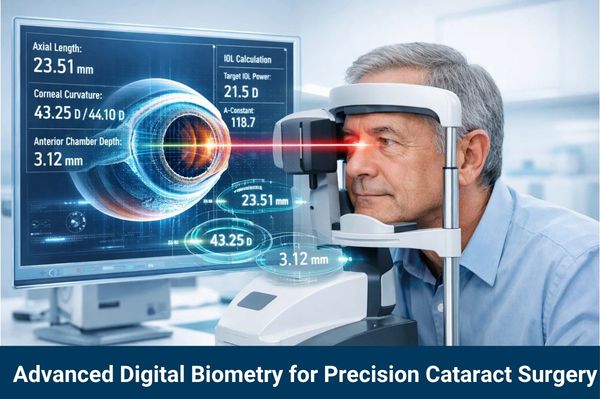
In the modern digital era, advanced non-contact scanners like the IOL Master and Lenstar have become the gold standard. These devices use laser interferometry to take highly detailed measurements of the eye’s axial length, corneal curvature and anterior chamber depth. By creating a high-resolution digital map of the eye, these scanners allow for Intraocular Lens (IOL) power calculations with pinpoint accuracy.
This digital biometry is the foundation of modern cataract removal. The data gathered during this phase dictates the exact power of the artificial lens to be implanted. This precision is what allows surgeons to offer patients a high probability of “emmetropia” – a state where they may no longer need glasses for distance vision after their cataract eye surgery. For patients, this means the transition from cloudy vision to crisp, clear sight is guided by data rather than estimation.
Cataract Treatment: Laser-Assisted Lens Fragmentation for Gentler Removal
While traditional cataract removal involves a surgeon using a handheld metal or diamond blade to make manual incisions, modern digital surgery often utilizes a Femtosecond Laser. This represents a monumental shift in laser treatment for cataract, moving from mechanical force to light-based precision.
The computer-guided laser system uses a sophisticated imaging interface to scan the eye and create a customized surgical plan. The laser then executes three critical steps with robotic precision:
- Corneal Incisions:Creating self-sealing, perfectly shaped tunnels for surgical access that heal faster than manual cuts.
- Capsulotomy: Creating a perfectly circular and centered opening in the lens capsule to house the new lens.
- Lens Fragmentation: Pre-softening and “dicing” the cataract into tiny pieces.
Because the laser pre-softens the cataract, the surgeon uses significantly less ultrasound energy (phacoemulsification) to remove the lens material. This “gentler” approach reduces the risk of energy-related trauma to the corneal endothelium, leading to reduced inflammation and a much faster healing trajectory. For many, laser eye surgery for cataracts is the preferred choice for its repeatability and enhanced safety profile.
Cataract Eye Surgery: Real-Time Surgical Guidance Systems as a Digital GPS
One of the most challenging aspects of manual cataract surgery is the precise alignment of specialized lenses, particularly toric lenses for cataract surgery used to correct astigmatism. Historically, surgeons would manually mark the eye with ink while the patient was sitting up. However, when a patient lies down, the eye can rotate (cyclotorsion), making manual marks inaccurate.
Today, digital guidance systems act as a surgical GPS, providing a “heads-up” display through the microscope. These systems take the digital map generated during the preoperative exam and “overlay” it directly onto the surgeon’s real-time view of the eye.
The surgeon sees high-tech digital markers that show exactly where to make incisions and, more importantly, the exact axis on which to align a toric lens. This removes the guesswork associated with manual marking, ensuring that astigmatism is corrected to the specific degree. This level of accuracy is vital for achieving the high-definition visual clarity that patients expect from modern cataract treatment.
Testimonials
“Extremely gentle, professional and informative, Could not wish for more”
Intraoperative Power Verification for Final Accuracy
Even with the most advanced preoperative mapping, the final resting position of a lens – known as the effective lens position – can vary slightly once the cataract is removed. To address this, digital technology like the ORA (Optiwave Refractive Analysis) system provides an intraoperative “real-time check.”
This technology allows the surgeon to perform a refractive power test during the procedure, specifically after the cloudy cataract has been removed but before the new lens is permanently secured. The system uses wavefront aberrometry to measure the eye’s focus in real-time while the patient is on the operating table.
This mid-surgery verification is particularly beneficial for:
- Patients with high levels of astigmatism.
- Patients who have previously undergone LASIK or PRK.
- Patients choosing premium multifocal or EDOF lenses.
By confirming the lens power mid-surgery, the surgeon can make adjustments on the fly, ensuring the chosen artificial lens is the perfect match for the patient’s eye. While this technology can influence the overall cataract surgery cost, the increased probability of a “perfect” visual result without the need for follow-up enhancements is a primary driver for its adoption in modern clinics.
Our Other Treatments
Intense Pulsed Light (IPL) for Dry EyesCataract Removal Treatment: 3D "Heads-Up" Visualization for Enhanced Precision
For decades, surgeons have performed cataract eye surgery by peering through the oculars of a traditional microscope. This required a fixed, often physically taxing posture for the surgeon and limited the view to a 2D-like perspective. Modern digital technology has introduced 3D “Heads-Up” Visualization.
In this setup, the surgeon operates while looking at a massive, high-definition 4K 3D digital screen while wearing specialized glasses. This “digital cockpit” provides:
- Enhanced Depth Perception: The 3D view offers better visualization of the delicate structures of the eye, such as the thin posterior capsule.
- Superior Magnification: Details are much larger and clearer than through traditional glass optics, allowing for more precise micro-movements.
- Digital Image Enhancement:Surgeons can adjust contrast and color filters digitally to see tissues that might be nearly invisible under a standard microscope.
This technology not only improves the precision of the surgeon’s movements but also allows the entire surgical team to see the procedure in high definition. This collaborative environment ensures that every step of the cataract removal surgery is monitored with the highest level of scrutiny.
Read Our Article
Top Tips for Managing Post-Cataract Surgery InflammationAdvanced Toric Lens for Cataract Surgery: Designs and Digital Analysis
The final piece of the digital puzzle is the lens itself. Digital engineering and advanced computer modeling have led to the creation of “smart” implants like Multifocal and EDOF (Extended Depth of Focus) lenses.
In the past, a standard lens could only provide clear vision at one distance (usually far away). However, these modern lenses use complex light-bending patterns – mastered through digital simulation – to provide a seamless range of vision.
- Multifocal Lenses:Use diffractive rings to split light into different focal points, allowing for reading, computer work and distance vision.
- EDOF Lenses:Create a continuous “string” of focus, which is particularly effective for active patients who want to transition from looking at a dashboard to the road without blur.
For patients with astigmatism, toric lenses for cataract surgery are now engineered with digital precision to counteract the irregular shape of the cornea. When these advanced lenses are combined with laser precision and real-time guidance, the result is a customized visual solution that effectively “de-ages” the eye’s optical system.
 Call Us Now!
Cataract Surgery Cost: Understanding the Investment and Outcomes
When discussing modern cataract treatment, it is important to address the cataract surgery cost. While basic cataract removal is often covered by insurance, the “refractive” packages that include laser eye surgery for cataracts or A verification and premium lenses usually involve out-of-pocket expenses. However, the value of these digital technologies lies in the quality of life they provide. The ability to perform daily activities – from reading a book to driving at night – without the constant reliance on glasses is a significant long-term benefit.
Conclusion
Digital technology has successfully turned cataract surgery from a standard medical necessity into a highly personalized refractive procedure. From the initial digital mapping of the eye’s curvature to the final placement of a computer-engineered lens, every micro-step is now guided by data, laser precision and high-definition visualization.
The transition from manual blades to laser treatment for cataract and the shift from ink marks to digital GPS overlays have made the procedure safer, more predictable and more accurate than ever before. For the modern patient, these digital advancements ensure that cataract treatment is not just about restoring sight, but about optimizing vision for a modern, active lifestyle.