
Summary
Choosing a surgeon for any procedure that permanently alters your vision is one of the most important decisions you will make about your health. The UK has many providers of laser eye surgery and lens-based vision correction, and the variation in surgeon experience, training, technology, and clinical standards is significant. This article provides a practical guide to understanding what accreditations matter, why consultant-led care differs from technician-led models, what questions to ask at a consultation, and why the background and experience of your surgeon is the single most important factor in your outcome. At Sussex Eye Laser Clinic, all assessments and surgical procedures are performed personally by Prof. Mayank Nanavaty, one of the UK’s most experienced and credentialled ophthalmic surgeons.
Why Surgeon Selection Matters More Than Any Other Factor
Laser eye surgery platforms and diagnostic technology are largely standardised across UK clinics. The hardware available to a surgeon at one well-equipped clinic is broadly comparable to that at another. What differs significantly between providers is the person making the clinical decisions: assessing your suitability, designing your treatment plan, performing your surgery, and managing your post-operative care.
Elective vision correction surgery carries very low risk overall, but it is performed on healthy eyes. There is no disease to treat if things go wrong. The burden of surgical skill and clinical judgement in delivering a consistently excellent result, and in identifying and managing the minority of cases where something unexpected arises, rests entirely on the surgeon.
Understanding UK Ophthalmic Accreditations
FRCOphth: The Royal College of Ophthalmologists Fellowship
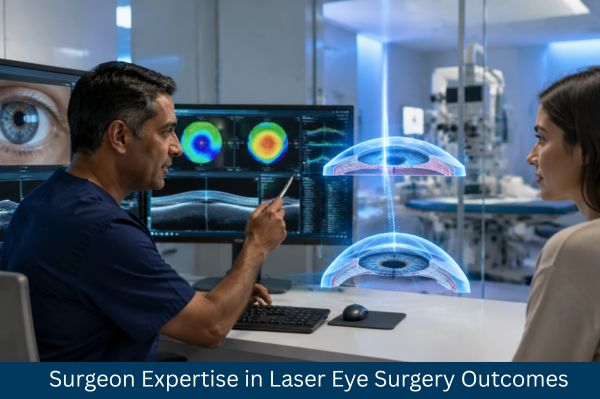
The Fellowship of the Royal College of Ophthalmologists (FRCOphth) is the primary professional qualification for fully trained ophthalmologists in the UK. It is awarded after completion of specialist medical training in ophthalmology, successful examination, and independent review of clinical competence. All consultant ophthalmologists in the NHS hold or are working towards this qualification.
Prof. Mayank Nanavaty holds FRCOphth alongside an MBBS medical degree, a DO (Diploma of Ophthalmology), and a PhD in clinical science related to ophthalmology. This combination represents the full range of academic and clinical training expected of a UK consultant ophthalmologist.
The Difference Between a Consultant Ophthalmologist and Other Practitioners
The title of Consultant Ophthalmologist in the UK is reserved for doctors who have completed the full surgical training pathway, passed the Royal College examinations, and been appointed to a substantive or honorary consultant post. At Sussex Eye Laser Clinic, all clinical decisions and surgical procedures are the direct responsibility of Prof. Nanavaty.
Some high-volume laser eye surgery providers use a model where patients are assessed by optometrists or clinical staff and then operated on by a surgeon who has brief contact with the patient. Prof. Nanavaty personally assesses every patient at Sussex Eye Laser Clinic, personally designs each treatment plan, and personally performs every procedure. This consultant-led model means continuity of care and full accountability throughout.
 Drop Us an Email!
CQC Registration
The Care Quality Commission (CQC) is the independent regulator of health and social care in England. Any clinic providing regulated activities, including surgical eye procedures, must be registered with the CQC and must meet its fundamental standards for safety, effectiveness, responsiveness, and leadership. CQC registration is a minimum requirement, not a quality differentiator on its own, but it confirms that a provider is operating within the regulatory framework and is subject to inspection.
Professional Society Memberships
Membership of specialist societies reflects active engagement with the latest clinical evidence, technique development, and peer review in the field. Prof. Nanavaty holds membership of:
- United Kingdom and Ireland Society of Cataract and Refractive Surgery (UKISCRS), of which he is currently serving as Honorary Secretary
- Royal College of Ophthalmologists (RCOphth)
- European Society of Cataract and Refractive Surgery (ESCRS)
- British Society of Refractive Surgery (BSRS)
- International Society of Refractive Surgery (ISRS)
- American Academy of Ophthalmology (AAO)
- American Society of Cataract and Refractive Surgery (ASCRS)
These memberships are not honorary. They involve active participation in scientific meetings, peer-reviewed publication, and the review of emerging evidence that informs clinical practice. A surgeon actively engaged at this level is at the frontier of their specialty, not simply practising from established training alone.
Testimonials
“Extremely gentle, professional and informative, Could not wish for more”
Academic and Research Roles
Prof. Nanavaty holds an Honorary Professorship at Brighton and Sussex Medical School and serves as Section Editor for the Eye Journal of the Royal College of Ophthalmologists, published by Springer Nature. He is Chief Examiner at the Certificate of Laser Refractive Surgery (CertLRS) examination of the Royal College of Ophthalmologists, the national examination for surgeons seeking accreditation in refractive surgery.
He serves on the Scientific Committees of both UKISCRS and BSRS, and is on the Scientific Committee for Cataract and Refractive Surgery at the Royal College of Ophthalmologists. His role as Clinical Lead for academic research, the contact lens department, teaching, and simulation at the Sussex Eye Hospital, University Hospitals Sussex NHS Foundation Trust, places him at the intersection of cutting-edge clinical practice and the training of the next generation of ophthalmic surgeons.
For patients, what this means practically is that their surgeon is not simply performing procedures learned during training. He is actively shaping the standards by which refractive surgery is performed and evaluated across the UK.
Questions to Ask at a Laser Eye Surgery Consultation
A thorough consultation should allow you to ask any question you have. The following are particularly useful for evaluating the quality of care you are being offered:
About Your Surgeon
- Are you a consultant ophthalmologist with FRCOphth, and will you personally perform my surgery?
- How many of this specific procedure have you performed, and what are your outcomes data?
- Are you affiliated with a teaching hospital or active in professional surgical societies?
About the Procedure and Your Suitability
- What specific technology will be used to assess my cornea, and what will it measure?
- Am I being assessed with corneal tomography, or only topography?
- Which procedure do you recommend for me specifically, and why?
- What are the risks specific to my prescription and corneal anatomy?
- What alternatives exist if I am not suitable for the procedure you are recommending?
About Post-Operative Care
- Who will I see at my post-operative reviews, you or a member of your team?
- If I have a complication or concern, who do I contact and how quickly will I be seen?
- Is there a policy on managing complications or retreatments, and is there any additional cost?
A surgeon who welcomes these questions and answers them with specific, evidence-based information is demonstrating the kind of transparency and accountability that good clinical practice requires.
 Call Now!
Why Patients Choose Sussex Eye Laser Clinic
Sussex Eye Laser Clinic operates from Nuffield Health Brighton Hospital, Nuffield Health Haywards Heath Hospital, and Spire St Anthony’s Hospital. Every patient is seen by Prof. Nanavaty from the first consultation to discharge. There are no hidden charges for the post-operative care pathway, and patients who have questions or concerns after surgery have direct access to the clinical team.
For patients who have been assessed at high-volume providers and are uncertain about their diagnosis, their treatment plan, or the recommendation they received, a second opinion consultation with Prof. Nanavaty offers independent, consultant-level reassessment.
Conclusion
Your choice of surgeon is the most consequential decision in your vision correction journey. A fully trained consultant ophthalmologist with FRCOphth, active specialist society involvement, a track record in clinical research, and a personal commitment to consultant-led care from first assessment to final review represents the highest standard of private practice in the UK. That is what Prof. Mayank Nanavaty offers every patient at Sussex Eye Laser Clinic. To book your consultation, visit sussexeyelaserclinic.co.uk or call 01273 083780.
Frequently Asked Questions
What is the CertLRS and why does it matter for my surgeon?
The Certificate of Laser Refractive Surgery is a nationally recognised postgraduate qualification awarded by the Royal College of Ophthalmologists specifically for surgeons performing laser eye surgery. It demonstrates a defined standard of knowledge and practice in refractive surgery. Prof. Nanavaty serves as Chief Examiner for this qualification, which places him at the forefront of defining that standard.
How do I verify that a surgeon is registered with the GMC and holds FRCOphth?
The General Medical Council (GMC) maintains a publicly accessible register at gmcuk.org where you can search any UK doctor by name and confirm their registration status, licence to practise, and any conditions or restrictions. FRCOphth can be confirmed by direct enquiry to the Royal College of Ophthalmologists if needed.
Is it safe to have surgery at a private hospital rather than an NHS facility?
Private hospitals in the UK are regulated by the CQC and are required to meet the same fundamental safety standards as NHS facilities. The equipment, surgical instruments, anaesthetic support, and infection control protocols are equivalent. The primary difference is the patient experience, waiting times, and the opportunity to choose your surgeon directly.
Can I get a second opinion at Sussex Eye Laser Clinic if I have already been assessed elsewhere?
Yes. Prof. Nanavaty is experienced in providing independent second opinions for patients who have received recommendations they want reviewed, are uncertain about their suitability assessment, or have had a procedure and have ongoing concerns. A second opinion consultation follows the same thorough assessment process as a standard consultation.