
Corneal Transplants: The Growing Burden of Fuchs’ Dystrophy
Imagine waking up every morning to a foggy world. Not because you forgot your glasses – but because your cornea is swollen. That’s daily life for many people living with Fuchs’ Dystrophy or those who have experienced a failed corneal transplant. The cornea, that crystal-clear window at the front of your eye, relies on a thin layer of endothelial cells to pump fluid out and keep vision sharp. When those cells stop working, fluid builds up, swelling occurs and vision becomes blurred and painful.
For decades, the standard solution has been a donor corneal transplant. Surgeons replace the damaged endothelial layer with healthy donor tissue. While effective, this approach comes with real challenges. Donor tissue shortages, risk of rejection and complex surgical techniques can make the process stressful and uncertain.
That’s where EndoArt® steps in. This Advanced Synthetic Corneal Transplant offers something revolutionary – a “no-donor” solution. Instead of relying on human tissue, it uses a precisely engineered synthetic implant to restore corneal clarity. For patients who’ve exhausted traditional options or are hesitant about donor surgery, this innovation represents more than technology. It represents hope.
Why Traditional Donor Transplants Aren’t Always the Perfect Fix
Traditional endothelial keratoplasty procedures, such as DMEK or DSAEK, have transformed eye care. But they’re far from perfect. First, there’s the donor issue. Healthy corneal tissue must come from a recently deceased donor and supply doesn’t always meet demand. In some regions, patients wait months.
Then there’s the surgery itself. Handling ultra-thin donor tissue requires extraordinary precision. Even in skilled hands, complications like graft detachment can occur. Patients often need strict postoperative positioning, lying face-up for hours to keep the graft in place. Rejection, although less common than with full-thickness transplants, remains a possibility.
And what happens when a transplant fails? Repeat donor surgeries become more complex and success rates may decline. For patients who have already undergone one or more procedures, the emotional and physical toll can feel overwhelming.
This is why the concept of a Synthetic Corneal Transplant is so compelling. It removes dependency on donor supply, eliminates rejection risk linked to foreign human tissue and simplifies surgical handling. Instead of replacing tissue with more tissue, EndoArt introduces a durable synthetic alternative designed specifically for function, not biology.
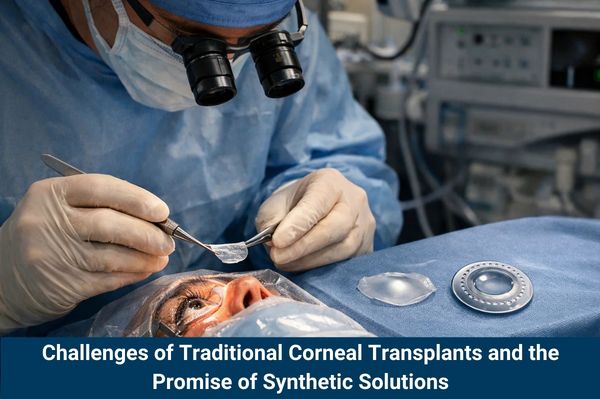
EndoArt® - A New Era in Synthetic Corneal Transplant Technology
EndoArt® isn’t just another implant. It represents a shift in thinking. Rather than mimicking every layer of the cornea, this Artificial Corneal Transplant focuses specifically on the endothelial function – the pump system responsible for fluid control.
Cleared for major US clinical trials in early 2026, EndoArt® has already attracted attention in ophthalmology circles worldwide. The implant is a thin, flexible polymer film designed to adhere to the inner surface of the cornea. It doesn’t attempt to replace cells. Instead, it restores balance through smart engineering.
That’s the beauty of an Advanced Synthetic Corneal Transplant. It asks a simple question: What’s the real problem? In Fuchs’ Dystrophy, the problem isn’t structural damage to the entire cornea. It’s fluid imbalance. Solve the fluid issue and you restore clarity.
By targeting function over form, EndoArt offers a streamlined solution that could reshape how corneal swelling is treated in the coming years.
Synthetic Corneal Transplant Check-Valve Mechanism - How It Controls Corneal Swelling
At the heart of this innovation lies what many describe as a “check-valve” mechanism. It sounds technical, but the concept is surprisingly intuitive.
In a healthy eye, endothelial cells pump fluid out of the cornea, maintaining transparency. When they fail, fluid seeps in faster than it can escape. Think of it like a basement flooding because the sump pump stopped working.
The Synthetic Corneal Transplant acts like a one-way gate. The specialized polymer film allows controlled movement of fluids while preventing excessive inflow. Instead of relying on living cells, it uses material science to create a barrier that stabilizes hydration levels.
This isn’t brute-force blocking. It’s controlled regulation. The implant attaches to the back surface of the cornea, forming a smooth interface that prevents ongoing leakage. Over time, the cornea naturally dehydrates to a clearer state, reducing swelling and improving vision.
By replicating the functional outcome of endothelial cells – without actually transplanting cells – this Advanced Synthetic Corneal Transplant provides a mechanical solution to a biological problem. It’s elegant in its simplicity.
Testimonials
“Extremely gentle, professional and informative, Could not wish for more”
Artificial Corneal Transplant - An Advanced Approach
If the technology sounds advanced, the procedure itself is surprisingly straightforward. The Artificial Corneal Transplant surgery typically takes about 30 minutes. No donor preparation. No delicate unfolding of fragile human tissue.
Through a small corneal incision, the surgeon inserts the thin polymer implant into the anterior chamber. It’s positioned against the inner corneal surface and secured using an air or gas bubble. This bubble gently presses the implant into place, allowing it to adhere properly.
Compared to traditional donor endothelial surgery, the handling is more predictable. Synthetic material doesn’t tear as easily, doesn’t vary in thickness and doesn’t carry biological unpredictability.
Recovery tends to be faster as well. While patients still need short-term positioning to ensure attachment, the absence of donor tissue reduces the risk of immune rejection. That means fewer long-term steroid drops and potentially fewer complications.
For many patients, especially those who have already experienced a failed graft, the simplicity of this Advanced Synthetic Corneal Transplant feels like a welcome relief.
Synthetic Corneal Transplant Re-Bubbling Reality - What Patients Should Expect
Let’s talk about something important: re-bubbling. It sounds dramatic, but it’s actually a minor follow-up adjustment.
After implantation, a small percentage of patients may experience partial detachment of the Synthetic Corneal Transplant. When that happens, surgeons perform a quick in-office or minor procedure to reintroduce an air bubble, pressing the implant back into place.
Why does this happen? Just like with donor grafts, the inner corneal surface must fully adhere to the implant. Natural eye movements, pressure changes or individual healing responses can sometimes loosen that contact.
The good news? Re-bubbling is typically fast and minimally uncomfortable. It doesn’t mean failure. It’s more like tightening a loose screw after installing a new fixture. Once reattached, the implant usually remains stable.
Patients should view this as part of the process rather than a complication. Clear communication with the surgeon and consistent follow-up care ensure optimal results.
Who Is the Ideal Candidate for an Advanced Synthetic Corneal Transplant?
Not every patient with corneal disease needs a Synthetic Corneal Transplant. The ideal candidates are those with endothelial dysfunction – particularly Fuchs’ Dystrophy or failed endothelial grafts – where the primary issue is fluid imbalance.
Patients with extensive scarring, structural corneal damage or advanced ocular disease may require different approaches. However, for individuals with relatively clear corneal structure but persistent swelling, EndoArt offers a targeted alternative.
It may be especially appealing for:
- Patients in regions with limited donor availability
- Individuals with previous graft rejection
- Those seeking a reduced risk of immune complications
- Patients wanting a shorter surgical time
As US clinical trials expand in 2026, clearer guidelines will emerge. But early data suggests that this Artificial Corneal Transplant could significantly expand treatment options.
 Call Us Now!
The Future of Artificial Corneal Transplant Innovation
Medicine is moving toward precision solutions. Instead of replacing entire structures, we’re learning to correct specific dysfunctions. EndoArt represents that philosophy in action.
As research continues, materials may evolve further – becoming thinner, more adaptive and even more efficient in regulating fluid flow. Surgeons may refine techniques, reducing re-bubbling rates and improving long-term outcomes.
The broader impact is just as exciting. Eliminating reliance on donor tissue could transform global corneal care. An Advanced Synthetic Corneal Transplant offers scalability.
Conclusion:
EndoArt® marks a turning point in how we think about corneal swelling. Instead of waiting for donor tissue or risking repeated graft failures, patients may soon have access to a reliable Synthetic Corneal Transplant that restores clarity through smart engineering.
With its innovative check-valve mechanism, minimally invasive 30-minute procedure and manageable re-bubbling adjustments, this Artificial Corneal Transplant represents a practical, forward-thinking solution for Fuchs’ Dystrophy and failed transplants.
The future of corneal care may no longer depend on donors. It may depend on design.