
Summary
Dry eye disease is the most common reason patients are advised to delay or reconsider laser eye surgery at an initial assessment. Many people come to Sussex Eye Laser Clinic having been told elsewhere that their dry eyes make them unsuitable, and are wondering whether this is permanent. In most cases it is not. This article explains what dry eye means for laser surgery eligibility, why severity matters more than the presence of dry eye alone, how the treatments available at Sussex Eye Laser Clinic can address the underlying cause, and why many patients who were initially deferred go on to have successful surgery once their tear film is treated.
Why Dry Eye Affects Laser Eye Surgery Suitability
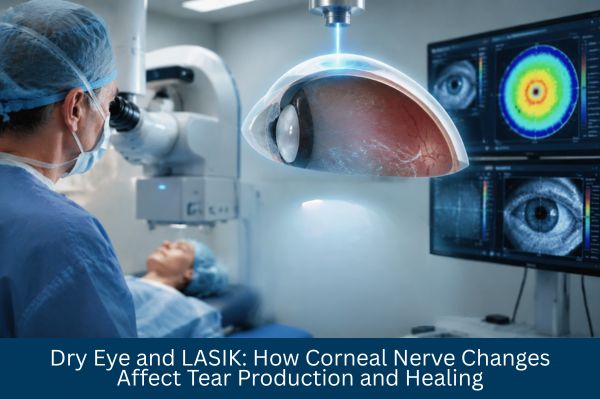
Laser eye surgery, and LASIK in particular, temporarily reduces the density of corneal nerves that pass through the area treated by the laser. These nerves carry the signal that drives the reflex arc for tear production. Reduced corneal nerve density means reduced reflex tearing in the post-operative period, which typically lasts from a few weeks to a few months before nerve regeneration restores normal sensitivity.
In patients with healthy, well-functioning tear film, this temporary reduction in reflex tearing is clinically manageable with lubricant drops and generally does not cause significant symptoms. In patients with pre-existing dry eye disease, especially meibomian gland dysfunction where the oily layer of the tear film is already compromised, the additional impact of reduced corneal sensation can worsen symptoms considerably, delay healing, and affect the quality and stability of the visual result.
This is why dry eye status is assessed carefully before any laser procedure is recommended. The goal is not to exclude all patients with any dry eye history, but to identify those whose tear film is likely to cause a problem and to treat it appropriately before surgery is proceeded with.
Understanding Dry Eye Severity
Mild Dry Eye
Patients with mild dry eye, characterised by occasional symptoms that respond well to lubricant drops, with intact meibomian gland function and an adequate tear film on examination, are generally suitable for laser eye surgery. Trans-PRK is often preferred over LASIK in these patients because it involves no flap creation and is associated with less post-operative reduction in corneal sensation.
Moderate Dry Eye
Patients with moderate dry eye, where symptoms are more frequent or persistent, the tear film breaks up quickly on examination, or meibomian gland function is compromised, are assessed for underlying cause before a surgery decision is made. For most of these patients, a structured treatment programme using Intense Pulsed Light (IPL) therapy improves tear film quality to a level where laser surgery becomes appropriate.
Severe Dry Eye
Patients with severe dry eye disease, Sjogren syndrome-related aqueous deficiency, severely compromised meibomian gland structure on imaging, or a history of significant ocular surface disease represent genuine contraindications to laser eye surgery. For these patients, Implantable Contact Lenses are an alternative that does not affect the corneal surface or its nerve density and is therefore better tolerated in eyes with challenging tear film status.
Meibomian Gland Dysfunction: The Most Common Underlying Cause
Meibomian gland dysfunction (MGD) is the most frequent cause of evaporative dry eye disease in the UK, and it is particularly prevalent in screen-heavy populations and in people who wear contact lenses for extended periods. The meibomian glands along the upper and lower eyelid margins produce the oily component of the tear film. When these glands become partially blocked, inflamed, or atrophied, the oily layer is insufficient to prevent tear evaporation between blinks.
The important point for laser surgery candidates is that MGD is treatable. It is not a permanent contraindication. Identifying and treating MGD before surgery, bringing the tear film to a stable and adequate state, allows many patients to proceed safely to laser correction.
How IPL Treatment at Sussex Eye Laser Clinic Restores Laser Eligibility
Intense Pulsed Light therapy for dry eye is a clinically established treatment that addresses the inflammatory component and gland dysfunction underlying evaporative dry eye. During IPL treatment, calibrated light pulses are delivered to the skin of the lower eyelids and the periocular area. The energy absorbed by abnormal blood vessels in the eyelid margin reduces the inflammatory mediators that drive meibomian gland dysfunction. The heat effect also liquefies the thickened meibum secretions in partially blocked glands, improving flow.
A typical treatment course at Sussex Eye Laser Clinic involves three to four IPL sessions spaced three to four weeks apart. Most patients notice meaningful improvement in symptoms within the first two sessions. After a post-treatment assessment confirming that tear film quality has reached an appropriate level, the laser surgery assessment is revisited and, in most cases, the patient is found suitable to proceed.
Prof. Nanavaty coordinates the dry eye treatment and laser assessment as part of an integrated pathway. Patients who come to Sussex Eye Laser Clinic with a history of dry eye are not simply turned away. They are assessed, a treatment plan is formed, and their journey to clearer vision continues with the appropriate care in the correct sequence.
Testimonials
“Extremely gentle, professional and informative, Could not wish for more”
Trans-PRK vs LASIK for Patients with Dry Eye Tendency
When a patient with a history of dry eye or borderline tear film is suitable for laser surgery, Trans-PRK is typically preferred over LASIK for two reasons. First, Trans-PRK does not create a corneal flap, which means there is no cutting of corneal tissue beyond the ablation zone itself. The corneal nerve architecture is less disrupted than in LASIK, and recovery of corneal sensation, and with it the return of reflex tearing, occurs more reliably. Second, Trans-PRK treats the epithelium and stroma as a single step, avoiding the creation of any interface that can affect tear film dynamics.
Patients with dry eye who choose Trans-PRK are given a structured post-operative care plan including lubricant drops, anti-inflammatory drops where appropriate, and close follow-up to monitor surface healing and tear film status.
 Call Now!
Conclusion
Being told you have dry eyes does not mean you can never have laser eye surgery. For the majority of patients who have been deferred due to dry eye, the underlying cause is meibomian gland dysfunction, which is treatable. Sussex Eye Laser Clinic offers IPL dry eye therapy as part of an integrated pre-operative pathway, and many patients who present with dry eye-related concerns go on to have successful laser correction. If you have been turned away elsewhere because of your tear film, a consultation with Prof. Nanavaty at Sussex Eye Laser Clinic will determine what your options are. Book your assessment at sussexeyelaserclinic.co.uk.
Frequently Asked Questions
How is dry eye severity assessed before laser surgery?
A comprehensive dry eye assessment includes tear film break-up time measurement, Schirmer testing for tear production volume, meibography to image the meibomian glands directly, examination of the eyelid margin and gland orifices, and a detailed symptom questionnaire. This combination gives a clear picture of both severity and underlying cause.
How many IPL sessions are needed before I can have laser surgery?
Most patients with moderate MGD-related dry eye require three to four IPL sessions before their tear film reaches a level suitable for laser surgery assessment. The exact number depends on individual response to treatment. A formal reassessment of tear film quality is performed after the treatment course to confirm suitability.
I have dry eyes but want vision correction. Can ICL be an option?
Yes. For patients with significant dry eye that makes laser surgery inadvisable even after treatment, Implantable Contact Lenses are an excellent alternative. The ICL sits inside the eye and does not touch the corneal surface, meaning it has no impact on corneal nerve density or the mechanisms of tear production. Many patients with moderate to significant dry eye achieve excellent, stable vision correction with ICL.
Will dry eye get worse after laser eye surgery?
In appropriately selected patients with mild or treated dry eye, temporary worsening of dryness after laser surgery is common in the first few months as corneal nerve density recovers. With appropriate lubricant and anti-inflammatory treatment, this usually resolves. Patients who have had dry eye properly assessed and treated before surgery have significantly better post-operative tear film outcomes than those who proceed without adequate pre-operative management.