
When you’re told you need corneal cross linking, it’s completely normal to feel a mix of relief and anxiety. Relief because there’s a treatment available. Anxiety because you probably have dozens of questions running through your mind.
Is it painful? Will it fix my vision? How long is recovery? Is it permanent?
This guide breaks down the most common concerns about Corneal Crosslinking, explained in simple, practical language. If you’re considering treatment at a corneal collagen cross-linking clinic or have already scheduled your procedure, here’s what you really need to know.
Corneal Cross Linking: Will It Fix My Vision So I Don’t Need Glasses?
This is the number one question people ask – and the most misunderstood part of the procedure.
Let’s be clear: corneal cross linking is not a vision-correcting surgery. It is a stabilizing procedure. Its primary goal is to stop the progression of conditions like keratoconus by strengthening the corneal collagen fibers in your eye.
Think of your cornea like the framework of a building. In keratoconus, that framework weakens and begins to bulge outward. Corneal Collagen Crosslinking works by creating new bonds – or “cross-links” – between collagen fibers. These new connections make the cornea stronger and more stable.
What does that mean for your eyesight?
- Some patients notice slight improvement.
- Many see no dramatic change.
- Most will still need glasses or specialty contact lenses.
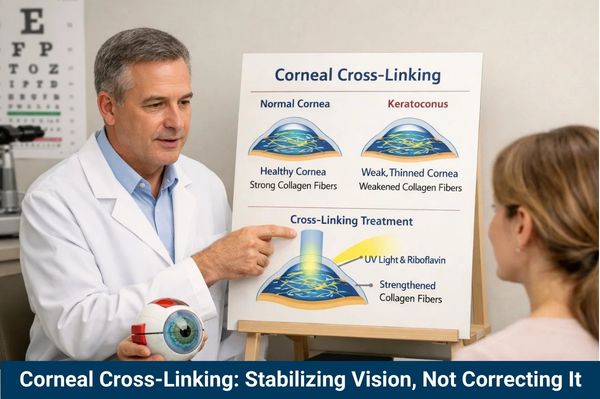
The purpose of Corneal Collagen Cross-linking is to “freeze” the condition where it is. It’s about preventing worsening vision, not eliminating prescription lenses. In fact, many patients still rely on scleral or RGP lenses after healing.
A Corneal Crosslinking Specialist will usually explain this clearly: stabilization is success. If your vision stays the same five or ten years from now instead of worsening, the treatment has done its job.
Corneal Cross Linking: How Long Until Vision Stabilizes After Surgery?
Recovery requires patience. Vision after Corneal Crosslinking follows a very predictable – but sometimes frustrating – timeline.
Immediately after surgery, your eye is healing from the removal of the surface layer. During this time:
- Vision is blurry.
- Light sensitivity is high.
- The eye may feel irritated.
For the first 1-2 weeks, vision often feels worse than before the procedure. This is completely normal. The cornea is rebuilding its surface while the internal strengthening process is underway.
From weeks 3 to 6, things begin to improve, but vision may fluctuate daily. Some mornings seem clearer than others. Some days feel foggy. That’s because the corneal collagen is remodeling itself.
Full stabilization usually takes 3 to 6 months and in some cases up to a year.
A Corneal Cross-linking Specialist monitors this process with follow-up scans. The shape of your cornea gradually settles as the new collagen bonds mature.
Patience is key here. It’s not a quick visual transformation. It’s a biological strengthening process happening at a microscopic level.
 Email Us
Corneal Cross Linking: Does the Laser Burn the Eye?
There’s a common misconception that a laser is used to “burn” or reshape the eye. That’s not what happens.
Corneal Cross Linking uses ultraviolet (UV) light – not a cutting laser. The UV light works in combination with riboflavin (Vitamin B2) eye drops.
Here’s how it works in simple terms:
- Riboflavin drops are applied to the cornea.
- The cornea absorbs the vitamin solution.
- UV light activates the riboflavin.
- This reaction creates new cross-links in the corneal collagen fibers.
No tissue is cut. No reshaping is performed. No burning occurs.
It’s more like reinforcing concrete with steel rods than sculpting it with tools. The UV light simply triggers a strengthening reaction inside the cornea.
Patients are often surprised at how calm the procedure feels. Your eye is completely numb during treatment and you simply look at a light for about 10-30 minutes depending on the protocol.
Choosing an experienced Corneal Crosslinking Specialist ensures that the correct UV intensity and riboflavin saturation levels are used for safety and effectiveness.
Corneal Cross Linking: How Painful Is the Recovery?
During the procedure itself, you won’t feel pain because numbing drops are used.
The real question is what happens after those drops wear off.
Most patients describe the first 24 to 48 hours as:
- Very gritty
- Irritating
- Moderately to significantly painful
- Like having sand stuck in the eye
This discomfort peaks within the first two days. The surface layer of the cornea is healing and that’s where most nerve endings are located.
Doctors usually prescribe:
- Pain-relieving drops
- Oral pain medication if needed
- Antibiotic and anti-inflammatory drops
By day three or four, discomfort decreases dramatically. By one week, most patients feel much better.
The key is planning ahead. Take time off. Rest. Keep lights dim. Follow your drop schedule carefully.
At a professional corneal collagen cross-linking clinic, you’ll receive detailed recovery instructions to make the healing phase manageable and safe.
Corneal Cross Linking: When Can I Return to Work or Screens?
This is one of the most practical concerns.
Most specialists recommend taking one full week off work. Even if your job is not physically demanding, visual discomfort can make concentration difficult.
Screens – phones, laptops, television – do not damage your eye after Corneal Collagen Crosslinking. However, they can significantly increase dryness and strain in the first few days.
For the first 3-4 days:
- Limit screen exposure.
- Use artificial tears frequently.
- Take breaks every 15-20 minutes if you must look at a screen.
By the end of the first week, many patients can comfortably return to desk work.
If your job involves dust, bright lights or physical strain, your Corneal Cross-linking Specialist may recommend additional time off.
Corneal Cross Linking: When Can I Wear Contact Lenses Again?
If you rely on RGP or scleral lenses, this question is crucial.
After Corneal Crosslinking, the cornea needs time to stabilize before lenses are reintroduced. Typically:
- Soft lenses: around 2-4 weeks
- RGP or scleral lenses: 4-6 weeks or longer
Why wait?
Because the shape of the cornea is still changing. Fitting lenses too early can cause discomfort or improper correction.
In many cases, patients need a new lens fitting after healing. Since the corneal collagen has strengthened and slightly reshaped during recovery, your previous lenses may no longer fit optimally.
Your provider at the corneal collagen cross-linking clinic will guide you through the re-fitting process when the cornea has stabilized.
Testimonials
“Excellent manner, listens really well and gives multiple opportunities to ask questions, which is really helpful. Very calm, gently spoken and not rushed”
Corneal Cross Linking: Can Both Eyes Be Treated at the Same Time?
Technically, yes. Practically, most surgeons prefer not to.
Why?
Because the first few days after Corneal Collagen Cross-linking can be uncomfortable and visually limiting. If both eyes are treated simultaneously, you may struggle significantly during recovery.
For that reason, many Corneal Crosslinking Specialists space treatments about 4-6 weeks apart.
This allows:
- One functional eye during recovery.
- Easier daily activities.
- Greater comfort overall.
However, every case is unique. In certain circumstances, bilateral treatment may be recommended.
Discuss the pros and cons with your specialist before deciding.
Corneal Cross Linking: Is It a Permanent Cure?
This is one of the most important long-term questions.
Corneal Cross Linking is not a cure that removes keratoconus. It does not restore the cornea to its original shape. But it is highly effective at halting progression.
Studies show that Corneal Collagen Crosslinking significantly reduces the likelihood of worsening bulging and thinning. For many patients, it prevents the need for a corneal transplant later in life.
In rare cases, progression can continue and a repeat treatment may be considered. But for the majority, one procedure provides long-term stability.
Think of it as reinforcing a weak structure before it collapses. You’re not rebuilding it from scratch – you’re strengthening what’s already there.
When performed by an experienced Corneal Cross-linking Specialist, long-term outcomes are overwhelmingly positive.
 Call Us Now!
Corneal Cross Linking: What Are the Risks of Corneal Haze?
“Corneal haze” sounds alarming, but it’s often a normal part of healing.
After Corneal Crosslinking, mild haze is common. It’s part of the remodeling process as the corneal collagen reorganizes and strengthens.
In most cases:
- Haze is temporary.
- It peaks within the first few months.
- It gradually clears.
Rarely, haze can persist and slightly affect clarity. Proper postoperative care – including prescribed steroid drops – reduces this risk significantly.
Regular follow-up visits at your corneal collagen cross-linking clinic ensure that healing is progressing normally.
The key takeaway? Mild haze is expected. Permanent haze is uncommon.
Conclusion:
Choosing Corneal Crosslinking is about protecting your future vision. It’s not a cosmetic procedure. It’s not a quick visual upgrade. It’s a strategic, preventive treatment designed to stabilize your cornea and preserve long-term eye health.
Understanding realistic expectations – about vision changes, discomfort, recovery time and outcomes – makes the journey smoother.
With the guidance of a qualified Corneal Crosslinking Specialist, proper aftercare and patience during recovery, most patients find the procedure well worth it.
Stability today means fewer complications tomorrow. And when it comes to your eyesight, that’s a powerful investment.