
Summary
Astigmatism affects approximately one in three people in the UK, often alongside short or long-sightedness. It causes blurred or distorted vision at all distances because the cornea or lens is not uniformly curved. Many people with astigmatism wonder whether laser eye surgery can correct it fully or whether they will always need glasses or contact lenses. This article explains what astigmatism is, how different vision correction procedures address it, what the limits of each approach are, and which patients achieve the best outcomes with each option.
What Is Astigmatism and Why Does It Cause Blurred Vision?
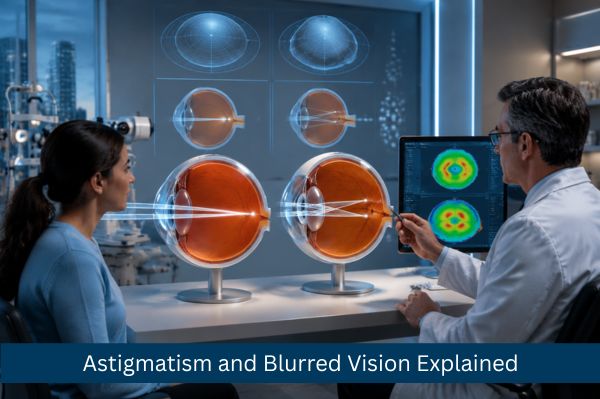
A normal cornea is spherical, like a football. A cornea with astigmatism is shaped more like a rugby ball, with one meridian more curved than the other. Light entering the eye through an astigmatic cornea does not converge to a single sharp point on the retina. Instead it focuses at two separate points, producing blur that is present at all distances rather than only close up or far away.
Astigmatism is measured in dioptres of cylinder, with the axis specifying the orientation of the steepest and flattest meridians. A reading like minus 1.50 cylinder at axis 180 describes the amount and direction of the corneal asymmetry. In clinical terms, astigmatism is described as regular (the two principal meridians are at right angles, which is correctable) or irregular (the distortion is not patterned, which is more complex to address).
Most astigmatism is regular and correctable with spectacles, contact lenses, or surgery. Irregular astigmatism, which can arise from conditions such as keratoconus, corneal scarring, or previous surgery, requires more sophisticated assessment and a tailored approach.
Read Our Article
What to Expect During Your ICL Surgery Consultation?Which Procedures Correct Astigmatism?
LASIK and Laser Eye Surgery
LASIK reshapes the corneal surface to correct both the spherical component (myopia or hyperopia) and the cylindrical component (astigmatism) simultaneously. It is highly effective for regular astigmatism up to approximately 5.00 to 6.00 dioptres of cylinder. Modern excimer laser platforms use eye-tracking and precise cyclotorsion control to ensure that the laser ablation is applied at exactly the right axis, even if the eye rotates slightly during treatment.
Residual astigmatism after LASIK is uncommon with modern systems, but small amounts may remain with very high cylinder corrections or in eyes with slight irregularities. A retreatment can address residual astigmatism if needed once the refraction has stabilised.
 Email Us Now!
Transepithelial PRK
Transepithelial PRK corrects astigmatism by the same ablation process as LASIK, without creating a flap. It is preferred for patients with thinner corneas, dry eye tendency, or active lifestyles involving contact sports. The correction of astigmatism is equally effective, though visual recovery takes slightly longer than with LASIK because the surface epithelium regenerates over the first few days.
Prof. Nanavaty performs Transepithelial PRK at Sussex Eye Laser Clinic and it is often the preferred approach for patients who want robust, long-term correction without the mechanical step of flap creation.
Our Other Treatments
YAG Laser CapsulotomyImplantable Contact Lenses (ICL)
For patients with higher degrees of astigmatism, thinner corneas, or significant dry eye that makes laser treatment less suitable, a toric ICL is an excellent alternative. The ICL is a thin, biocompatible lens placed inside the eye, in front of the natural lens. Toric ICLs are manufactured with a cylindrical component built into the lens, correcting astigmatism without removing any corneal tissue.
The ICL is reversible, does not alter the cornea permanently, and is particularly well suited to patients with high prescriptions. Astigmatism correction with a toric ICL is highly accurate when the lens is correctly aligned at surgery.
Toric Intraocular Lenses (IOL)
For patients undergoing cataract surgery or refractive lens exchange, toric intraocular lenses correct astigmatism at the time of lens replacement. The natural clouded or non-preferred lens is removed and replaced with a toric IOL calculated to correct the existing cylindrical error. This approach is ideal for older patients who want both cataract correction and astigmatism management in a single procedure.
What Are the Limits of Astigmatism Correction?
Most regular astigmatism up to 5.00 to 6.00 dioptres can be fully corrected by laser or lens-based techniques. There are important nuances:
- Very high astigmatism above 6.00 dioptres may be better addressed with a toric ICL or toric IOL than with laser, which has tissue removal limits.
- Irregular astigmatism caused by keratoconus requires corneal stabilisation with CXL before any refractive correction is considered. Topography-guided PRK after CXL can reduce irregular astigmatism in carefully selected patients.
- Axis-related complexity, where the astigmatism is oblique rather than with-the-rule or against-the-rule, does not prevent correction but may require a slightly longer assessment to plan precisely.
- Small residual amounts of astigmatism after surgery, typically less than 0.50 dioptres, may not be optically significant and may not require retreatment.
Testimonials
“Extremely gentle, professional and informative, Could not wish for more”
Comparing Astigmatism Correction Options
| Procedure | Astigmatism Range | Tissue Preserved | Reversible | Best Suited To |
| LASIK | Up to ~5.00 D cyl | No | No | Moderate astigmatism, adequate corneal thickness |
| Trans-PRK | Up to ~5.00 D cyl | No | No | Thin corneas, active lifestyles, dry eye tendency |
| Toric ICL | Up to ~6.00 D cyl | Yes | Yes | High prescriptions, thin corneas, dry eyes |
| Toric IOL (RLE/Cataract) | Up to ~6.00 D cyl | Yes | No | Patients over 45, cataract coexisting |
A comprehensive assessment at Sussex Eye Laser Clinic maps the cornea in detail using topography and tomography, measures the exact degree and axis of astigmatism, and determines which approach will deliver the most complete and stable correction for your specific anatomy.
Our Other Treatments
Advanced Synthetic Corneal TransplantConclusion
Astigmatism is highly correctable for the vast majority of people who have it. Laser eye surgery, implantable contact lenses, and toric intraocular lenses each offer reliable correction across a range of astigmatism severities. The right choice depends on the degree of astigmatism, corneal thickness, age, and overall eye health. Prof. Nanavaty at Sussex Eye Laser Clinic carries out a thorough pre-operative assessment to determine which procedure will achieve the clearest and most durable result. To find out which option is appropriate for you, book a consultation at sussexeyelaserclinic.co.uk.
 Call Us Now!
Frequently Asked Questions on Astigmatism & Vision Correction
Can LASIK or PRK completely eliminate astigmatism?
In most cases, yes. Modern laser platforms correct regular astigmatism very precisely. Residual astigmatism below 0.50 dioptres is uncommon and is usually not visually significant. Higher degrees of astigmatism may require a toric ICL for the most complete correction.
I have been told my astigmatism is too high for laser surgery. What are my options?
A toric ICL or a toric intraocular lens at the time of refractive lens exchange are both capable of correcting higher degrees of astigmatism than laser surgery can safely address. Both options are available at Sussex Eye Laser Clinic.
Will astigmatism come back after laser surgery?
In patients with stable, regular astigmatism and no underlying corneal conditions, the correction from laser surgery is permanent. The cornea retains its new shape. However, if an undetected corneal condition such as keratoconus was present before surgery, progression of that condition can change the refraction over time. This is why thorough pre-operative corneal mapping is essential.
Does astigmatism correction make surgery more complicated or riskier?
No. Correcting astigmatism alongside myopia or hyperopia does not significantly increase surgical risk when performed on appropriate candidates with modern technology. The laser treatment plan simply includes both the spherical and cylindrical correction in a single ablation pattern.