
The human eye is a marvel of biological engineering and the cornea – the clear, dome-shaped surface that covers the front of the eye – plays a vital role in vision by focusing incoming light. However, when this “window” becomes clouded or scarred due to disease, injury or infection, the result is often profound vision loss or total blindness. For decades, the gold standard for restoring sight has been the human donor transplant. Yet, a staggering global crisis remains: there simply aren’t enough donor corneas to go around.
As of 2026, medical science has reached a pivotal junction. The emergence of the Artificial Corneal Transplant and the Synthetic Corneal Transplant is no longer a distant dream but a rapidly advancing reality. Could these lab-engineered solutions finally bridge the gap for the millions of people waiting in the shadows of blindness?
Synthetic Corneal Transplant: Addressing the Global Donor Crisis
The statistics surrounding corneal blindness are sobering. Researchers estimate that over 12.7 million people worldwide are currently waiting for a corneal transplant. The disparity is even more alarming when looking at the supply-demand ratio: globally, there is only one donor cornea available for every 70 patients who need one.
This shortage is most acute in developing nations across Asia, Africa and the Middle East, where cultural barriers, religious beliefs and a lack of sophisticated eye-banking infrastructure make donor retrieval difficult. A synthetic corneal transplant offers a revolutionary way to bypass these hurdles. Unlike human tissue, which requires a donor’s death and immediate preservation, synthetic options are “off-the-shelf” products. They can be manufactured at scale, shipped worldwide and stored for extended periods, providing a consistent supply that could eventually eliminate the concept of a “waiting list.”
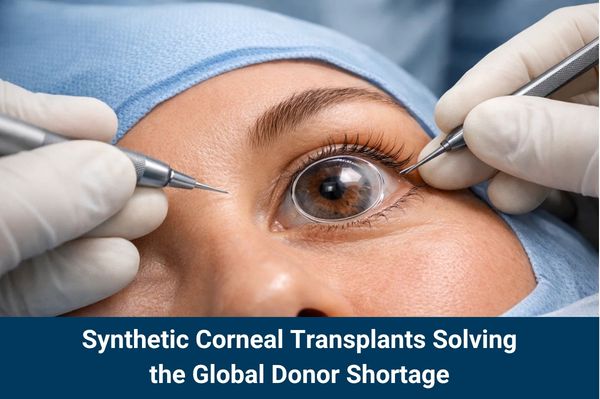
Artificial Corneal Transplant: A Lifeline for High-Risk Patients
For many patients, a traditional human donor transplant isn’t even an option. In cases of severe chemical burns, autoimmune disorders or multiple previous graft failures, the body’s immune system is highly likely to reject human tissue. This is where the artificial corneal transplant, specifically devices like the Boston Keratoprosthesis (KPro), becomes a medical necessity.
Artificial corneas are typically made from medical-grade plastics like polymethyl methacrylate (PMMA) or advanced biocompatible hydrogels. Because these materials are non-organic, they do not trigger the same immune “red flags” as donor cells. By using an artificial corneal transplant, surgeons can restore vision to patients who were previously deemed “untreatable,” offering a permanent optical solution that resists the scarring and rejection that plague biological grafts.
Synthetic Corneal Transplant: Advancements in Bio-Integration and 2026 Innovation
The primary challenge with earlier versions of the synthetic corneal transplant was “bio-integration” – how well the eye’s natural tissue bonded with the synthetic material. If the bond was weak, the implant could leak or even be extruded (pushed out) by the eye.
However, in 2026, the landscape has shifted thanks to nanotechnology and biomimetic materials. Modern synthetic corneas are often coated with specialized proteins or “growth factors” that encourage the patient’s own corneal cells to grow directly into the edges of the implant. This creates a seamless, watertight seal. Some of the latest synthetic corneal transplant models even use lab-grown collagen that mimics the human stroma, allowing the eye to “accept” the implant as part of its own structure rather than a foreign object.
Artificial Corneal Transplant vs. Traditional Keratoplasty: The Pros and Cons
Choosing between a human donor and an artificial corneal transplant involves a careful evaluation of the patient’s specific condition.
- Traditional Keratoplasty (Human Donor):
- Pros:Natural tissue, better peripheral vision and a long history of success in low-risk cases.
- Cons:High risk of rejection, requires long-term steroid use and is subject to donor shortages.
- Artificial Corneal Transplant (Synthetic):
- Pros:Zero risk of biological rejection, immediately available and suitable for the most damaged eyes.
- Cons:Requires lifelong monitoring, higher risk of secondary issues like glaucoma and expensive upfront costs.
While a synthetic corneal transplant might cost significantly more than a donor procedure in the short term, the long-term savings – avoiding multiple failed surgeries and the constant need for anti-rejection medications – make it an increasingly attractive economic option for healthcare systems.
Synthetic Corneal Transplant: The Economic and Accessibility Factor
In 2026, emerging markets like India and China have become hubs for artificial corneal transplant innovation. By developing localized, lower-cost synthetic models, these regions are making sight-restoration accessible to the middle class, reducing the reliance on Western eye-banking imports. The shift from a “charity-based” donor model to a “manufacturing-based” synthetic model is arguably the most significant step toward achieving universal eye health.
Testimonials
“Excellent manner, listens really well and gives multiple opportunities to ask questions, which is really helpful. Very calm, gently spoken and not rushed”
Artificial Corneal Transplant: What Does the Future Hold?
The future of the artificial corneal transplant lies in personalization. With the advent of 3D bioprinting, researchers are now testing custom-fit corneas that match the exact curvature and thickness of a patient’s unique eye. This precision reduces post-operative astigmatism and significantly speeds up the recovery process.
Furthermore, “smart” synthetic corneal transplant devices are being developed with embedded sensors to monitor intraocular pressure. This is a game-changer for artificial cornea recipients, as it allows for the early detection of glaucoma – one of the most common complications after surgery.
 Call Us Now!
Conclusion
So, are synthetic corneal transplants the key to solving the global shortage of donor corneas? The answer is a resounding “yes,” but with a caveat. While the synthetic corneal transplant offers a definitive solution to the supply crisis and provides hope for high-risk patients, it is not yet a total replacement for the human donor cornea in every scenario.
The artificial corneal transplant has evolved from a “last resort” treatment to a sophisticated, front-line option. As we move through 2026 and beyond, the continued refinement of biocompatible materials and the lowering of manufacturing costs will likely see synthetic options become the primary choice for corneal restoration globally. For the millions currently waiting in darkness, these lab-grown “windows to the world” represent more than just a medical advancement – they represent the gift of a future seen clearly.