
Summary
Sussex’s coastal location makes it home to an exceptionally active population: surfers, cyclists, swimmers, climbers, runners, rugby players, and martial artists. For anyone who plays sport at any level, the question of how laser eye surgery interacts with their activity is important before making a decision. This article explains how each laser procedure and the implantable contact lens option relates to sport participation, why the choice of procedure matters for contact sport athletes in particular, and what realistic return-to-sport timelines look like for each treatment. Prof. Mayank Nanavaty at Sussex Eye Laser Clinic has extensive experience advising active patients on the procedure that best fits both their visual needs and their sporting life.
Why Sports Matter When Choosing a Vision Correction Procedure
Most people considering laser eye surgery think primarily about their daily prescription, age, and corneal thickness. For the active patient, there is an additional dimension: what happens to the treated eye if there is an impact to the face, head, or eye area, and how quickly can they return to the activities they love?
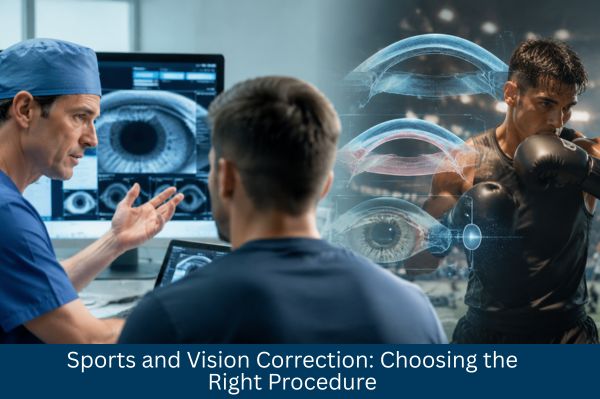
The answer differs significantly depending on the procedure chosen. LASIK creates a corneal flap that, while it heals securely for everyday activities, can theoretically be displaced by a direct, high-force impact to the eye in the months following surgery. Transepithelial PRK and ICL surgery do not create a flap, making them structurally more robust choices for athletes in contact sports.
LASIK and Sport
LASIK is one of the most widely performed laser eye surgery procedures in the UK and worldwide. It delivers fast visual recovery, with most patients achieving good functional vision within 24 to 48 hours. For the majority of sporting activities, LASIK patients can return to non-contact sport within one to two weeks and to most gym activities within the same period.
The flap created during LASIK integrates very well with the surrounding corneal tissue over time. For the vast majority of sport types including running, cycling, swimming (with goggles), gym training, tennis, golf, and racket sports, a healed LASIK flap presents no practical concern.
The caution applies to contact sports involving significant risk of impact to the eye or face: boxing, rugby, martial arts such as judo, BJJ, and MMA, ice hockey, and similar disciplines. In these sports, a direct blow to the eye carries a theoretical long-term risk of flap displacement, even years after surgery. For patients committed to these sports, Prof. Nanavaty recommends considering Transepithelial PRK or ICL instead.
 Email!
Transepithelial PRK and Sport
Transepithelial PRK is a flapless procedure. Rather than creating a hinged flap of corneal tissue, it removes the surface epithelium and reshapes the underlying stroma directly with the excimer laser. Once the epithelium regenerates and the cornea heals, there is no flap, no interface, and no structurally weak zone that could be disrupted by external force.
This makes PRK the laser procedure of choice for athletes in contact sports. The treated cornea after PRK has essentially normal structural integrity once healed. There is no theoretical concern about impact-related flap displacement because there is no flap.
The trade-off is recovery time. Visual recovery after PRK takes longer than after LASIK. Most patients achieve functional driving vision within one to two weeks, but optimal vision and full stability can take six to twelve weeks. The surface discomfort in the first few days post-operatively is also more noticeable than with LASIK.
Return to water sports (swimming, surfing) is typically possible after four weeks once the surface has fully healed. Contact sport can usually resume from six to eight weeks, subject to the individual’s healing assessment at a post-operative review.
Our Other Treatments
Intense Pulsed Light (IPL) for Dry EyesImplantable Contact Lenses (ICL) and Sport
The ICL is placed inside the eye without touching the cornea at all. Because no corneal tissue is removed and no surface healing occurs, the eye retains full structural integrity after surgery. From a sport and impact perspective, the ICL-treated eye is as structurally robust as an untreated eye.
Recovery is faster than PRK. Most ICL patients achieve excellent vision within 24 to 48 hours. Return to non-contact sport is typically possible within one week. For contact sports, the recommended pause is usually two to four weeks, primarily to allow the small peripheral incisions to heal fully rather than because of any structural vulnerability of the eye itself.
The ICL is the preferred option for patients with high prescriptions (above minus 8.00 dioptres) who participate in contact sports, as it combines the safety and recovery advantages of a flapless approach with the ability to correct prescriptions that may be too high for laser treatment alone.
Sport-Specific Guidance
| Sport Type | LASIK | Trans-PRK | ICL | Return to Sport (Approx) |
| Running, cycling, gym | Suitable | Suitable | Suitable | 1 to 2 weeks |
| Swimming (with goggles) | Suitable | Suitable | Suitable | 2 to 4 weeks |
| Tennis, golf, racket sports | Suitable | Suitable | Suitable | 2 to 3 weeks |
| Rugby, football, hockey | Caution advised | Preferred choice | Preferred choice | 6 to 8 weeks (PRK), 2 to 4 weeks (ICL) |
| Boxing, MMA, martial arts | Not recommended | Preferred choice | Preferred choice | 6 to 8 weeks (PRK), 2 to 4 weeks (ICL) |
| Surfing, water sports | Suitable after healing | Suitable after healing | Suitable after healing | 4 weeks (PRK/LASIK), 2 to 3 weeks (ICL) |
These timelines are approximate and are subject to individual healing assessment. All patients at Sussex Eye Laser Clinic receive a post-operative review programme that confirms when return to each type of sport is appropriate for them specifically.
Read Our Article
Laser Eye Surgery: Unveiling the TransformationTestimonials
“Extremely gentle, professional and informative, Could not wish for more”
Sussex's Active Outdoor Community
Brighton and the wider Sussex region has a particularly active outdoor culture. The South Downs, the coastal swimming scene, the sailing community at Shoreham and Brighton Marina, the strong cycling and triathlon networks, and several active rugby and martial arts clubs make sport participation a genuine priority for many patients seeking vision correction.
Prof. Nanavaty at Sussex Eye Laser Clinic is experienced in advising patients whose sport is central to their lifestyle. The consultation process for active patients includes a specific discussion about the sporting demands of their daily life to ensure the right procedure is selected, not just for their prescription but for their life.
 Call Now
Conclusion
For most recreational sport, all three procedures, LASIK, Transepithelial PRK, and ICL, are compatible with a return to full activity within a few weeks. For contact sport athletes, Transepithelial PRK and ICL are the recommended choices because neither creates a corneal flap. If you are active and considering vision correction, the team at Sussex Eye Laser Clinic will help you find the approach that works for both your eyes and your sport. Book a consultation at sussexeyelaserclinic.co.uk.
Our Other Treatments
Corneal Collagen Crosslinking (CXL) Eye SurgeryFrequently Asked Questions on Laser Eye Surgery
Can I swim after laser eye surgery?
Swimming with goggles is typically fine from two to four weeks after LASIK, from four weeks after PRK, and from two to three weeks after ICL surgery. Open water swimming and contact with pool water without goggles should be avoided for at least four weeks in all cases to reduce the risk of infection during surface healing.
I play rugby every weekend. Which procedure should I choose?
For contact sport athletes, Transepithelial PRK or ICL is strongly recommended over LASIK. Both are flapless procedures. ICL has the faster recovery and allows an earlier return to full contact sport, typically two to four weeks. PRK requires a longer pause of six to eight weeks but achieves equivalent long-term outcomes. A consultation will determine which is more suitable for your prescription and corneal anatomy.
Is it safe to wear protective eyewear over a laser-treated eye when playing sport?
Yes. Sports goggles and protective eyewear are compatible with all laser and ICL procedures once healed. They can be worn over a treated eye without any concern. Before surgery, many athletes find that prescription sports goggles are an unsatisfactory solution because of fit, weight, and compatibility with helmets. Vision correction removes this problem entirely.