
If you are considering ICL eye surgery, knowing what happens at your consultation helps you walk in prepared and walk out confident. This is not a routine eye check. It is a structured clinical assessment that determines whether you are a suitable candidate, what type of implantable contact lens will work best for you and what the procedure will involve from start to finish. Here is a clear breakdown of everything you can expect.
ICL Eye Surgery: Understanding What the Consultation Is Really For
ICL eye surgery consultation is more than just a brief chat with your surgeon. It is a dedicated diagnostic session that takes anywhere between one to two hours, depending on the complexity of your vision profile. The primary objective is to establish whether your eyes are anatomically suitable for a lens implant and to gather the precise measurements needed to customise your procedure. Unlike a general eye examination, this appointment is specifically designed to evaluate your candidacy for implantable contact lens surgery and to create a personalised treatment plan.
Implantable Contact Lenses: Initial Medical History and Vision Assessment
Implantable contact lenses are not suitable for everyone, which is why your consultation begins with a thorough review of your ocular and general medical history. Your surgeon will ask about your current prescription, how stable your vision has been over the past one to two years, any history of eye disease or injury and any medications you are currently taking. This stage also includes a detailed refraction test to measure your existing prescription accurately, establishing the baseline from which your ICL lens specification will be calculated.
Our Other Treatments
Corneal Collagen Crosslinking (CXL) Eye Surgery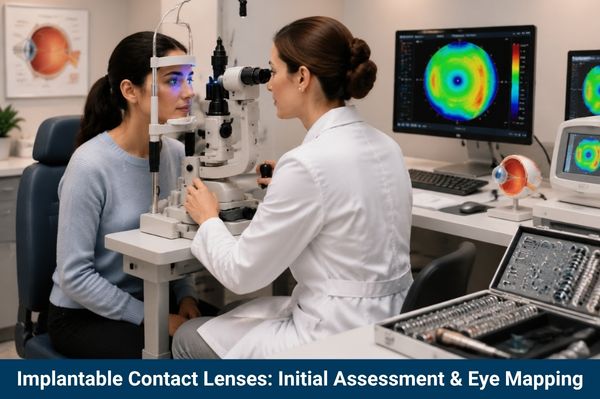
Implantable Contact Lens Surgery: Corneal Topography and Eye Mapping
Implantable contact lens surgery requires a highly detailed map of your eye’s internal and external dimensions. During the consultation, your surgeon will carry out corneal topography, which creates a three-dimensional surface map of your cornea. This identifies any irregularities in shape that could affect surgical outcomes. Anterior segment OCT (optical coherence tomography) is also typically performed to measure the internal structures of the eye, including the angle between your iris and cornea and the depth of your anterior chamber. These measurements directly influence the size and type of implantable contact that will be ordered for your procedure.
 Email Us Now!
ICL Lens Sizing and Vault Assessment during Consultation
The Implantable Contact Lenses must fit precisely within your eye, sitting just in front of your natural lens without touching it. This space, referred to as the vault, is critical. Too little vault causes pressure on the natural lens; too much increases the risk of elevated intraocular pressure. Using the data gathered from your corneal mapping and OCT scans, your surgeon will calculate the appropriate lens size. Most clinics now use proprietary sizing software alongside manual measurements to achieve the most accurate fit. Getting this right at the consultation stage is what makes implanted contact lenses a safe, long-term solution for vision correction.
Read Our Article
Top 10 Signs that Suggest Implantable Contact Lens (ICL) SurgeryImplantable Lenses: Pupil Dilation and Retinal Examination
Implantable lenses sit between the iris and the natural crystalline lens, so examining the health of your entire eye – including the retina – is essential before surgery is confirmed. Your pupils will be dilated using eye drops during the consultation, allowing your surgeon to inspect the lens, retina, optic nerve and peripheral retina in full detail. Any pre-existing retinal conditions, such as tears, lattice degeneration or early signs of macular changes, need to be identified and addressed before you proceed. This step is non-negotiable and forms a core part of every responsible implantable contact lens surgery consultation.
Intraocular Pressure Testing and Endothelial Cell Count
Two further measurements are critical at this stage. First, intraocular pressure (IOP) is tested to rule out glaucoma or any predisposition to elevated eye pressure, which is a contraindication for ICL surgery. Second and arguably more important, is the endothelial cell count. The endothelium is the inner layer of your cornea. Implanted contact lens surgery requires a sufficient density of these cells to ensure the cornea remains healthy after a lens is placed inside the eye. If the cell count is below the accepted threshold, Implantable Contact Lens Treatment will not be recommended. Your consultant will explain the results clearly and discuss what they mean for your suitability.
Our Other Treatments
Corneal TransplantsContact Lens Implant Surgery: Discussing Surgical Planning and What Comes Next
Once all assessments are complete, your surgeon will review the entire dataset with you and explain the surgical plan. This includes confirming which Implantable Contact Lense model has been selected, discussing whether one eye or both eyes will be treated and in what sequence, explaining how the lens is inserted through a small incision and positioned in place and outlining the expected recovery timeline. You will also be told how to prepare in the days before contact lens implant surgery, including stopping the use of soft or rigid contact lenses for a specified period beforehand, as this can affect corneal shape measurements. Any pre-operative peripheral iridotomy laser treatment, used in some cases to prevent pressure build-up after implantation, will also be discussed and scheduled if required.
Testimonials
“Excellent manner, listens really well and gives multiple opportunities to ask questions, which is really helpful. Very calm, gently spoken and not rushed”
About Sussex Eye Laser Clinic
Sussex Eye Laser Clinic, led by Consultant Ophthalmic Surgeon Prof. Mayank A. Nanavaty (MBBS, DO, FRCOphth, PhD), has been delivering specialist eye care since 2014 across Brighton, Haywards Heath and Sutton. With over 18 years of expertise in lens and cornea-based refractive surgery, Prof. Nanavaty personally conducts all procedures, offering tailored consultations and advanced treatments including implantable contact lenses, cataract surgery, laser refractive surgery and more.
Conclusion
Your ICL surgery consultation is a comprehensive clinical process that covers everything from your medical history and precise eye measurements to surgical planning and cost discussions. Each step exists to ensure the procedure is safe, accurately planned and matched to your individual vision needs. Going in with a clear understanding of what to expect helps you engage meaningfully with your surgeon, ask the right questions and make a well-informed decision about whether implantable contact lens surgery is the right path for you.