
Everything You Need to Ask: A Guide to Your Artificial Corneal Transplant Consultation
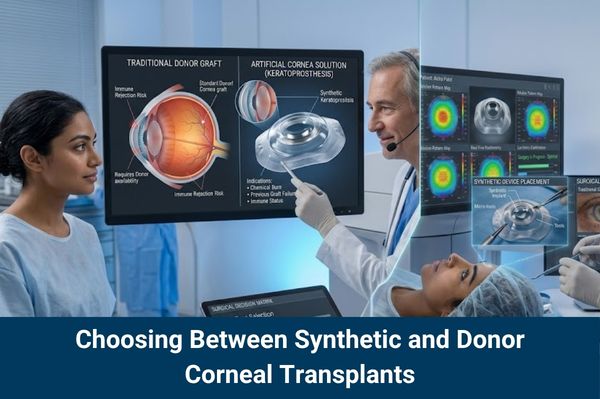
Choosing to undergo a major ocular surgery is a life-altering decision that requires extensive research and professional guidance. When traditional donor grafts are no longer a viable option due to high rejection risks or severe ocular surface disease, a synthetic solution becomes the primary pathway to restoring sight.
The following guide outlines the most searched and critical questions you should bring to your specialist. Each section is designed to address the clinical, practical and long-term realities of living with a permanent ocular prosthetic.
Artificial Corneal Transplant: Am I a better candidate for synthetic or donor tissue?
The most fundamental question involves understanding why a biological graft is not the first choice. An artificial corneal transplant, scientifically known as a keratoprosthesis (KPro), is typically reserved for “high-risk” cases where the body’s immune system is likely to reject human tissue.
Ask your surgeon: “Based on my specific pathology, why is a synthetic device a better choice for me than a human donor graft?”
Generally, a synthetic corneal transplant is recommended for patients with a history of multiple failed donor grafts, severe chemical burns or autoimmune conditions like Stevens-Johnson Syndrome. In these environments, human tissue often scars or melts, whereas the medical-grade plastic of a synthetic graft remains clear.
Synthetic Corneal Transplant: What are the long-term success and survival rates for my condition?
Patient data shows that “longevity” is the most searched topic regarding this surgery. However, success is highly dependent on the underlying health of the rest of the eye.
Ask your surgeon: “What is the 5-year and 10-year ‘retention rate’ of this specific synthetic corneal transplant for someone with my diagnosis?”
While the plastic lens itself cannot decay, the interface where the synthetic corneal transplant meets your natural eye tissue is the critical point of failure. You should ask for data specific to your condition – for example, success rates for a patient with corneal scarring are often higher than for a patient with severe end-stage autoimmune disease.
Our Other Treatments
Laser Refractive Eye SurgeryArtificial Corneal Transplant: How will this procedure impact my existing glaucoma management?
Glaucoma is the leading complication associated with an artificial corneal transplant. Because the device is rigid, traditional methods of measuring eye pressure (like the “puff of air” or blue light test) no longer work accurately.
Ask your surgeon: “How will you monitor my intraocular pressure (IOP) once the artificial corneal transplant is in place?”
Since the surgeon cannot “feel” the pressure through the plastic lens, they often rely on digital palpation (feeling the eye through the eyelid) or specialized imaging. If you already have glaucoma, you must ask if a glaucoma drainage shunt needs to be implanted simultaneously with the artificial corneal transplant.
Testimonials
“Excellent manner, listens really well and gives multiple opportunities to ask questions, which is really helpful. Very calm, gently spoken and not rushed”
Synthetic Corneal Transplant: What does the lifelong medication and "bandage lens" routine involve?
A synthetic corneal transplant is not a “set it and forget it” procedure. It requires a permanent commitment to ocular hygiene and preventative medicine.
Ask your surgeon: “What is the daily eye drop schedule and will I need to wear a ‘bandage’ contact lens indefinitely?”
Most patients must wear a large, clear contact lens 24/7 to protect the ocular surface and maintain moisture around the device. Furthermore, to prevent “endophthalmitis” (a devastating internal infection), you will likely be required to use antibiotic drops every single day for the rest of your life. Understanding this commitment is essential before agreeing to the surgery.
Artificial Corneal Transplant: What are the primary risks of device "extrusion" or "melting"?
Because an artificial corneal transplant involves a man-made object sitting within living tissue, the most searched concern is device stability.
Ask your surgeon: “What are the early warning signs of ’tissue melting’ or ‘extrusion’ around the hardware?”
Extrusion occurs when the eye tissue thins and the device begins to loosen. Another common issue is a “retroprosthetic membrane” – a thin layer of scar tissue that grows behind the plastic lens, clouding the vision. You need to know exactly which symptoms (like a sudden “soft” feeling in the eye or a new shadow in your vision) constitute a medical emergency.
Synthetic Corneal Transplant: How much functional vision can I realistically expect to gain?
Patients often ask if they will be able to drive or read again. The answer depends entirely on the health of your retina and optic nerve, which are located at the back of the eye.
Ask your surgeon: “If the synthetic corneal transplant stays perfectly clear, what is the maximum visual acuity my retina is biologically capable of achieving?”
If you have underlying retinal damage from long-term glaucoma or macular degeneration, the clearest synthetic corneal transplant in the world will not result in 20/20 vision. This question ensures your expectations are aligned with the physical limitations of your eye’s internal “wiring.”
Our Other Treatments
Refractive Lens Exchange Surgery Call Us Now!
Artificial Corneal Transplant: What are the specific lifestyle and environmental restrictions?
Physical activity and your work environment play a massive role in the long-term safety of an artificial corneal transplant.
Ask your surgeon: “Are there specific activities, such as swimming or contact sports, that I must avoid permanently?”
Infection is the greatest enemy of a synthetic corneal transplant. Consequently, swimming in pools, lakes or hot tubs is often strictly discouraged due to the risk of waterborne bacteria entering the eye around the device. High-impact activities are also risky, as a blow to a “synthetic eye” can cause catastrophic damage compared to a natural eye.
Conclusion
Embarking on the journey of an artificial corneal transplant is a brave step toward reclaiming independence. While a synthetic corneal transplant offers a miraculous alternative for those who have exhausted all other options, it comes with a high level of responsibility. Success is not just measured by the surgery itself, but by the lifelong partnership you maintain with your surgical team. By asking these targeted, SEO-informed questions regarding candidacy, pressure management and daily maintenance, you can approach your procedure with the confidence and clarity required for a successful visual outcome.