
Corneal Cross Linking: Stabilise Cornea & Treat Vision Fluctuations
This article aims to explore corneal collagen crosslinking (CXL) as an effective treatment for corneal ectasia and vision fluctuations, particularly following surgery. We will discuss the benefits, procedure and how CXL helps in stabilizing the cornea after surgery, specifically focusing on iatrogenic ectasia and its role in improving visual stability.
Introduction:
Corneal collagen crosslinking (CXL) has emerged as a promising solution for managing corneal ectasia and vision fluctuations, particularly after refractive surgery. This innovative procedure aims to enhance the structural integrity of the cornea by strengthening its collagen fibers, thus offering a long-term solution for individuals who experience vision instability. Whether used as a treatment for progressive corneal diseases or a corrective measure after refractive surgery, corneal crosslinking provides a viable path to stabilizing vision and improving quality of life.
Corneal Crosslinking: A Key Treatment for Corneal Ectasia
Corneal ectasia is a condition where the cornea becomes weak and begins to bulge outwards, leading to distorted vision. This condition can occur naturally, as seen in keratoconus or as a result of refractive surgery, where the corneal structure may become compromised, a situation known as iatrogenic ectasia. In both cases, corneal collagen crosslinking has proven to be an effective means of stabilizing the cornea and halting the progression of the disease.
Corneal collagen crosslinking involves the use of riboflavin (Vitamin B2) and ultraviolet (UV) light to strengthen the bonds between collagen fibers in the cornea. By doing so, the cornea becomes more rigid, reducing the risk of further bulging or thinning. This procedure can prevent the need for more invasive treatments such as corneal transplants, making it a highly beneficial option for patients suffering from corneal ectasia.
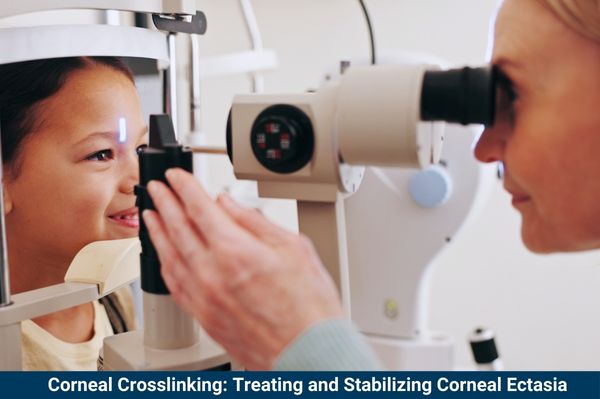
Corneal Crosslinking Treatment: How It Works to Stabilise Cornea
The procedure for corneal collagen crosslinking begins with the application of riboflavin drops to the surface of the cornea. This step helps the corneal tissue absorb the riboflavin, preparing it for the crosslinking process. Once the riboflavin is adequately absorbed, the eye is exposed to ultraviolet (UV) light for a specified duration. This exposure triggers a chemical reaction that creates stronger crosslinks between the collagen fibers, enhancing the structural integrity of the cornea.
The benefits of corneal crosslinking treatment are clear in its ability to slow or stop the progression of corneal diseases like keratoconus and its role in stabilizing the cornea after surgery is significant. This procedure is minimally invasive and typically performed under local anesthesia, allowing patients to recover relatively quickly.
Our Other Treatments: YAG Laser Capsulotomy

Corneal Collagen Crosslinking: Improves Vision Stability & Fluctuations
For individuals who experience fluctuating vision or progressive corneal thinning, corneal collagen crosslinking offers a pathway to greater visual stability. This technique works by strengthening the collagen matrix in the cornea, reducing the risk of further vision changes. Patients who have undergone refractive surgeries, may notice fluctuating vision post-surgery due to the weakening of the corneal structure. Crosslinking can address this instability by reinforcing the cornea, resulting in a more predictable and stable visual outcome.
In addition to improving visual acuity, corneal collagen cross-linking can reduce the need for corrective lenses in some cases, as the procedure may result in a more stable and regular corneal shape. This is particularly important for patients whose vision has been compromised by progressive corneal thinning.
Testimonials
“Excellent manner, listens really well and gives multiple opportunities to ask questions, which is really helpful. Very calm, gently spoken and not rushed”
Corneal Collagen Cross Linking Procedure for Treating Vision Fluctuations
The corneal collagen cross linking procedure is performed in a controlled environment, typically in an outpatient setting. The following steps outline the typical process:
- Anesthesia: Anesthetic eye drops are applied to numb the surface of the eye, ensuring that the procedure is painless.
- Corneal Preparation: The outermost layer of the cornea (the epithelium) may be gently removed to allow better absorption of the riboflavin drops. This step ensures the active ingredient penetrates the corneal tissue more effectively.
- Application of Riboflavin: Riboflavin drops are then applied to the cornea for approximately 20-30 minutes. This step allows the corneal tissue to absorb the riboflavin, which is essential for the subsequent crosslinking reaction.
- UV Light Exposure: Once the riboflavin has been adequately absorbed, the cornea is exposed to ultraviolet light for a prescribed amount of time. The UV light activates the riboflavin, leading to the creation of crosslinks between collagen fibers.
- Post-Procedure Care: After the procedure, patients are typically prescribed antibiotic and anti-inflammatory eye drops to promote healing and prevent infection. Most patients can return to normal activities within a few days, though vision may fluctuate as the cornea heals.
Corneal Crosslinking Specialist: Choosing the Right Doctor
Selecting a skilled corneal crosslinking specialist is crucial for the success of the procedure. A qualified specialist will conduct a thorough evaluation of the patient’s corneal health and determine if corneal collagen crosslinking is the right treatment option. Factors such as corneal thickness, the extent of corneal ectasia and the patient’s overall eye health are all considered when determining eligibility for the procedure.
Dr. Mayank Nanavaty, as a leading corneal crosslinking specialist with experience in treating both natural and iatrogenic corneal ectasia. Specialists who stay up-to-date with the latest advances in corneal surgery and CXL techniques can provide the best possible care and improve patient outcomes.
Read Our Article: What Is Corneal Crosslinking?

The Future of Corneal Collagen Cross-linking
Corneal collagen crosslinking has already proven to be a game-changer in the treatment of corneal ectasia and post-surgical vision fluctuations. As technology advances, it is likely that new variations of the procedure will emerge, potentially improving the speed, safety and effectiveness of treatment. Researchers continue to explore ways to enhance the benefits of CXL, such as improving its application in early-stage keratoconus and reducing recovery times.
For patients dealing with progressive corneal conditions or those experiencing vision fluctuations after refractive surgery, corneal collagen crosslinking offers a hopeful and effective solution. By stabilizing the cornea and preventing further deterioration, CXL plays a pivotal role in preserving vision and enhancing the quality of life for many individuals.
Our Other Treatments: Corneal Transplants
Conclusion:
Corneal collagen crosslinking is a valuable treatment option for individuals with corneal ectasia or those experiencing vision fluctuations following refractive surgery. Through its ability to strengthen and stabilize the cornea, CXL offers an effective way to preserve vision and prevent the need for more invasive procedures. As research continues to evolve, corneal collagen crosslinking will likely remain a cornerstone of corneal surgery, providing patients with a safe and reliable solution for their eye care needs.